
Views: 0 Author: Site Editor Publish Time: 2026-06-08 Origin: Site
Engineers and procurement teams constantly face intense pressure to maintain heavy-duty machinery. You need reliable mechanical principles, clear operational limits, and strict sourcing criteria for fluid film bearings. High-speed industrial operations simply cannot afford unexpected failures or extended outages.
Unplanned downtime in high-load equipment like turbines, compressors, and large motors is incredibly costly. Selecting or repairing the right bearing material becomes absolutely critical to protect expensive rotor shafts. You must ensure maximum equipment longevity under these demanding operational conditions.
This guide provides a complete technical and commercial breakdown of fluid film systems. We will focus deeply on operational mechanics, failure identification, and rigorous supplier evaluation. You will learn exactly how to specify, inspect, and source these vital components properly.
Core Function: A Babbitt bearing relies on a soft alloy lining and hydrodynamic lubrication to reduce friction and protect critical, high-cost rotor shafts from damage.
Strategic Advantage: Offers superior embeddability and conformability compared to rolling-element bearings, making them ideal for high-speed, heavy-load industrial environments.
Maintenance Reality: Susceptible to "wiping" and fatigue if lubrication is compromised; requires rigorous oil film monitoring.
Sourcing Criteria: Evaluating repair (re-pouring) versus replacement requires assessing the vendor's casting methods, ultrasonic testing capabilities, and alloy compliance.
Engineers rely heavily on specific metallurgical mixtures for heavy machinery. The composition of Babbitt metal typically features tin-based or lead-based alloys. These alloys contain hard microscopic crystals suspended inside a much softer metallic matrix. The hard crystals support the intense mechanical load. Meanwhile, the soft matrix allows the material to adapt slightly to operational forces.
Its primary purpose serves as a sacrificial wear layer. If system lubrication fails, the lining will intentionally smear or melt. This self-destructive action protects the highly expensive steel rotor shaft from catastrophic scoring. You can replace a Babbitt Bearing much more easily than rebuilding a ruined turbine shaft.
These components do not function through direct metal-to-metal contact during normal operation. They rely entirely on a principle called hydrodynamic lubrication. The operational mechanics follow a very specific physical sequence.
Stationary resting state: The heavy shaft rests directly on the bottom lining before startup.
Initial rotation: The shaft begins turning and acts like a mechanical pump.
Fluid drawing: Rotation pulls lubricating oil into the microscopic clearance space.
Wedge formation: A high-pressure fluid wedge develops beneath the spinning journal.
Complete separation: This high-pressure wedge physically lifts the shaft off the surface.
Once lifted, the shaft rides entirely on this thin film of pressurized oil. This eliminates mechanical friction almost completely. It allows continuous operation at extreme speeds for decades.
Industrial oil supplies frequently carry microscopic dirt or metal shavings. The soft metal lining provides a crucial property known as embeddability. It absorbs these tiny contaminants safely into its surface. The foreign particles sink into the soft matrix safely. They do not protrude outward to scratch the spinning shaft.
Additionally, large machinery often experiences slight structural shifting or thermal expansion. The lining offers excellent conformability. It can deform microscopically to adjust for slight shaft misalignments. This prevents localized high-pressure spots. Without this conformability, rigid bearings would fracture under uneven loads.
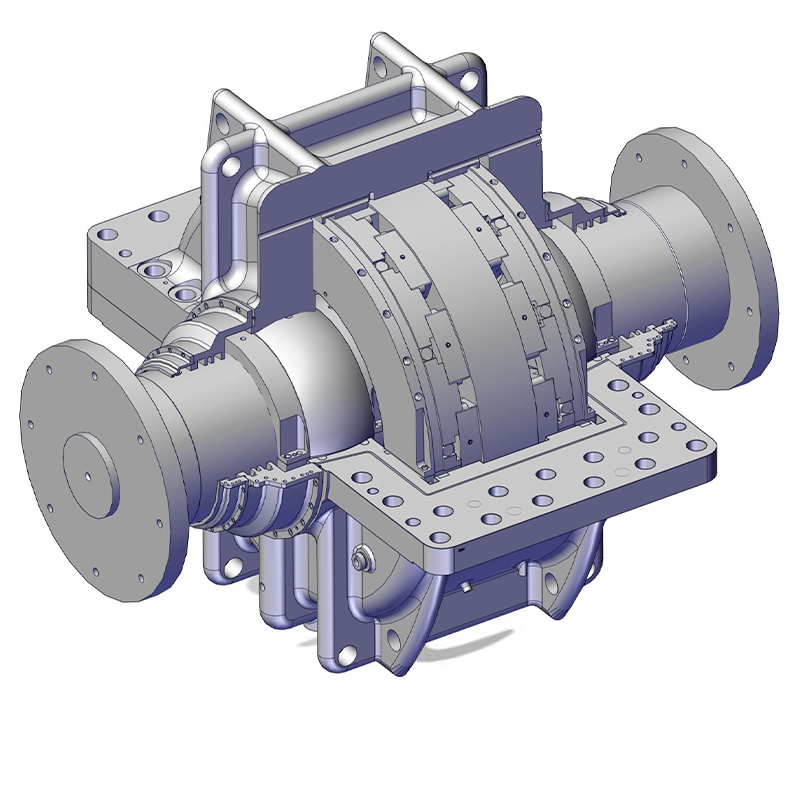
You must establish clear baseline success criteria before selecting your bearing type. Fluid film systems excel in environments featuring high surface speeds. They dominate in continuous operation scenarios like power generation. They handle heavy radial and axial loads effortlessly.
Standard rolling-element bearings often fail under these specific extremes. The constant high-speed impacts cause severe metal fatigue in ball or roller designs. Conversely, fluid film systems spread the load over a much larger surface area. You should specify them whenever rotational speeds and load weights exceed roller fatigue limits.
Choosing the correct alloy mixture dictates operational success. Engineers generally decide between two primary categories. You must match the material chemistry strictly to your operational environment.
| Property | Tin-Based Alloy (ASTM Grade 2) | Lead-Based Alloy |
|---|---|---|
| Primary Base | Tin (Sn) - 88% or more | Lead (Pb) - 75% or more |
| Strength Level | Higher structural integrity | Lower fatigue strength |
| Corrosion Resistance | Excellent against acidic oils | Vulnerable to specific acids |
| Ideal Applications | Turbines, high-speed compressors | Low-speed fans, railcars |
| Cost Profile | Higher material expense | Highly cost-effective |
Tin-based mixtures maintain their structural integrity at higher speeds and temperatures. Lead-based variants offer better boundary lubrication properties during dry startups. However, lead-based options lack the fatigue strength necessary for massive turbine rotors.
You must respect strict environmental boundaries to prevent premature failure. These materials possess specific temperature thresholds. They typically begin losing significant structural strength above 300°F (150°C). Most industrial operators set warning alarms much lower to ensure absolute safety.
Furthermore, these systems rely absolutely on a continuous, clean oil supply. Even a momentary interruption in fluid pressure will cause rapid heat spikes. Without oil, the hydrodynamic wedge collapses instantly. The resulting friction will destroy the soft metal lining within seconds.
Vendors utilize different methods to apply the molten metal to the backing shell. You must understand how these methods affect long-term reliability. We can summarize the differences using a simple structural comparison chart.
| Feature | Centrifugal Casting | Static (Gravity) Pouring |
|---|---|---|
| Process | Spins shell at high RPM while pouring | Pours metal manually into stationary shell |
| Density | Highly dense, voids pushed inward | Prone to trapped air bubbles |
| Bond Strength | Exceptional metallurgical bonding | Variable, depends on manual skill |
| Use Case | Industrial-grade heavy machinery | Quick repairs or antique restoration |
Centrifugal casting remains the preferred choice for demanding industrial applications. The spinning action forces heavy metal outward against the shell. This creates a highly dense structure free of internal voids. Static pouring often serves better for rapid, low-stress repairs.
Molten material will not stick to bare steel or cast iron naturally. A successful pour relies entirely on a critical preparation step called tinning. Technicians first clean the backing shell using aggressive chemical fluxes. They then apply a microscopically thin layer of pure bonding alloy.
This intermediate layer creates a permanent chemical and mechanical bond. The newly poured lining fuses directly to this tinned surface. If the tinning process fails, the thick lining will eventually detach from the backing shell. This detachment leads directly to rapid operational failure.
Equipment managers constantly face the decision to either repair or replace damaged units. You need a clear decision logic to evaluate these options properly. You should generally re-pour an existing shell if the steel backing remains structurally sound.
Melting out the old material and re-pouring new alloy takes significantly less time. It bypasses the massive lead times required to machine a brand-new custom shell. You also avoid expensive tooling costs. You should only machine a completely new unit if the original shell shows severe warping or deep structural cracks.
Operators must identify wear patterns early to prevent catastrophic shaft damage. Visual inspections during planned outages reveal several distinct failure modes.
Wiping: This appears as smeared or melted metal across the load zone. Overheating or sudden loss of oil pressure causes this damage.
Fatigue Cracking: This manifests as a mosaic of tiny cracks or missing chunks (spalling). Cyclic overloading or severe vibration typically drives fatigue failure.
Scoring: You will see deep, parallel grooves running along the rotational path. Severe particulate contamination in the oil supply causes these deep scratches.
Corrosion: This looks like dark, pitted areas on the metal surface. Acidic degradation of the lubricating oil aggressively attacks the softer matrix.
You cannot rely solely on visual inspections during occasional machine shutdowns. Modern industrial facilities utilize continuous monitoring systems. Emphasize the necessity of integrating Resistance Temperature Detectors (RTDs) or thermocouples. They provide real-time temperature data directly from the load zone.
Furthermore, you must utilize vibration analysis tools continuously. Vibration probes catch early signs of fluid-film instability. Phenomena like "oil whirl" or "oil whip" create distinct vibrational frequencies. Catching these instabilities early allows operators to adjust oil viscosity or temperature before physical damage occurs.
You must verify material integrity strictly before installing any new or repaired unit. Never assume a newly poured surface contains zero internal defects. You should mandate specific testing protocols during the procurement phase.
Suppliers must utilize Ultrasonic Testing (UT). This non-destructive method uses sound waves to check bond quality between the lining and the shell. UT easily identifies hidden voids or areas of detachment. You should also request Dye Penetrant testing. This process highlights invisible surface cracks before they grow under operational stress.
Selecting the right manufacturing or repair facility requires strict vetting. You must look beyond simple pricing structures. Define what technical capabilities matter most for a reliable Babbitt Bearing facility.
Search for vendors holding verified ISO 9001 certifications. This ensures baseline process repeatability. They should also possess in-house metallurgical testing equipment. This allows them to verify alloy chemistry before every single pour. Finally, strong reverse engineering capabilities matter greatly. Old machinery often lacks original blueprints, requiring vendors to map dimensions via laser scanning.
Industrial outages cost facilities thousands of dollars per hour. Commercial reality demands extremely fast response times from your chosen partners. Suppliers must offer rapid re-Babbitting services on a 24/7 emergency basis.
However, speed cannot sacrifice quality control. Even during a weekend emergency rush, the supplier must provide verified QA/QC documentation. You need signed ultrasonic test reports and dimensional inspection sheets upon delivery. Do not accept rushed components without an accompanying paper trail.
You need to transition from theoretical knowledge to active site management. Prompt your maintenance team to audit their current performance data immediately. Review historical temperature logs and vibration trends for all critical machinery.
Gather exact shaft dimensional tolerances and current oil chemistry reports. Once you compile this data, consult with a certified fluid-film specialist. Request a comprehensive engineering review or submit an RFQ for upcoming outage spares. Proactive planning eliminates the panic of sudden equipment breakdowns.
Specifying these systems requires a careful balance of material science, strict lubrication management, and precise manufacturing techniques.
Regular monitoring of oil film integrity and bearing temperatures prevents unexpected mechanical breakdowns.
Evaluating casting methods and verifying ultrasonic testing results ensures long-lasting repairs.
Partnering with a transparent, highly capable vendor improves overall reliability and safeguards operational continuity.
Action Step: Contact an experienced engineering team today to request a comprehensive assessment, secure a custom pouring quote, or troubleshoot any chronic machinery failures.
A: The terms describe different aspects of the same component. "Babbitt" refers specifically to the soft metal alloy lining used to reduce friction. "Journal" refers to the cylindrical mechanical design where a shaft rotates inside a shell. Therefore, a Babbitt bearing serves as a specific material type of journal bearing.
A: Standard operational safe zones typically range between 130°F and 180°F. Facilities usually set warning alarms around 200°F. Absolute trip limits sit tightly around 230°F to 250°F, depending on the specific alloy. Beyond these temperatures, the soft metal rapidly loses structural strength and begins to melt.
A: Under perfect hydrodynamic conditions with perfectly clean oil, their lifespan can be virtually indefinite. The shaft never touches the metal. However, real-world lifespans depend heavily on operational variables. Frequent start/stop cycles, oil contamination, and shaft misalignment significantly reduce their practical longevity.
A: Yes, technicians can repair severely damaged units very effectively. They melt out the old, damaged metal entirely. They clean and re-tin the steel shell, then pour new molten alloy. Machinists then turn the new lining down to precise original specifications. This process works much faster than sourcing completely new parts.


