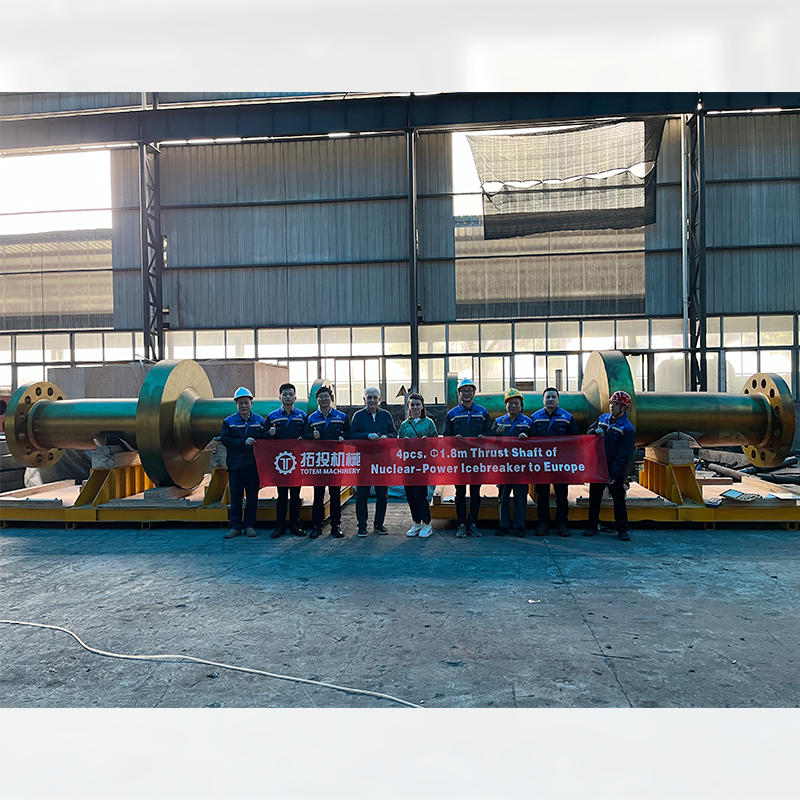
Why do polar ships need higher-standard thrust shafts? In marine propulsion systems, the thrust shaft is a key component that transmits power from the main engine to the propeller, directly affecting the reliability of the vessel’s navigation.
Read More →Diagnose reciprocating compressor crosshead wear to prevent costly downtime. Master clearance inspections and repair vs. replacement strategies.
Read More →Selecting reciprocating compressor cylinder material is vital for safety and life-cycle cost. This article compares three cast families: iron (grey/ductile), steel (carbon/low-alloy), and stainless (austenitic CF8M/CF3M, martensitic 17-4PH). It examines strength, hardness, thermal conductivity, expansion, self-lubrication, corrosion resistance, weldability, and failure modes (wear, corrosion, cracking, creep).
Read More →Why do polar ships need higher-standard thrust shafts? In marine propulsion systems, the thrust shaft is a key component that transmits power from the main engine to the propeller, directly affecting the reliability of the vessel’s navigation.
Read More →Diagnose reciprocating compressor crosshead wear to prevent costly downtime. Master clearance inspections and repair vs. replacement strategies.
Read More →Selecting reciprocating compressor cylinder material is vital for safety and life-cycle cost. This article compares three cast families: iron (grey/ductile), steel (carbon/low-alloy), and stainless (austenitic CF8M/CF3M, martensitic 17-4PH). It examines strength, hardness, thermal conductivity, expansion, self-lubrication, corrosion resistance, weldability, and failure modes (wear, corrosion, cracking, creep).
Read More →This article analyzes small crankshaft manufacturing for reciprocating compressors. These core components endure alternating loads over 200 MPa, speeds to 3000 r/min, thin oil film, and -20 to 80°C temperatures. Material choice prioritizes 40CrNi2MoA for fatigue strength, with 42CrMo as economic alternative. Process includes die forging (ratio >=3), quenching/tempering to 28-34 HRC core, surface hardening to 54-58 HRC, and precision machining to IT7, Ra <=0.4 μm. Quality control covers dimensions, hardness, MPI, UT, with three-level inspection. Failure prevention targets fatigue, wear, cracking, and imbalance. A case study achieved 99.5% yield. Cost breakdown shows machining as largest share; batch optimization and near-net-shape forging reduce costs. Trends include laser hardening, 3D repair, in-process sensing, composites, and green quenchants. Zero-defect production integrates materials, heat treatment, precision machining, and quality management for reliable compressor operation.
Read More →Professional guide to the casting and assembly of reciprocating compressor cylinder blocks. Covers key casting difficulties, systematic process solutions, core assembly challenges, and rigorous testing procedures to ensure stable and reliable cylinder performance under industrial operating conditions.
Read More →The piston rod in a reciprocating compressor connects the crosshead to the piston head, transmitting axial force through every compression cycle. When it fails, the compressor stops.
Read More →