
Views: 0 Author: Site Editor Publish Time: 2026-06-20 Origin: Site
Engineers constantly face a difficult mechanical dilemma in heavy industrial applications. Choosing between the traditional, fluid-film reliability of a Babbitt bearing and the standardized, low-friction appeal of a roller bearing remains notoriously challenging. Each distinct technology brings very specific operational advantages to rotating heavy machinery. This crucial engineering decision directly impacts unplanned downtime, routine maintenance schedules, and overall equipment lifespan. Relying on the incorrect bearing type inevitably causes premature mechanical failures. It can severely limit your facility's daily operational capacity. Plant managers and mechanical engineers must thoroughly understand how dynamic load variables strictly dictate component selection. This comprehensive guide provides a purely technical, application-based framework for evaluating both bearing types. We will deeply examine mechanical load distribution, continuous rotational speeds, and inherent structural retrofit risks without any manufacturer bias. You will learn exactly when to specify each vital component to guarantee optimal, long-term machinery reliability.
Load Distribution: Babbitt bearings rely on hydrodynamic fluid films for infinite surface-area load distribution, whereas roller bearings rely on localized point or line contact.
Speed vs. Start-Up: Roller bearings excel in frequent start-stop or low-speed applications; Babbitt bearings dominate in continuous, high-speed, heavy-load environments (e.g., turbines, large motors).
Maintenance Reality: Roller bearings are modular and easier to replace, while Babbitt bearings require specialized pouring and scraping skills but can often be rebuilt in place.
The "Soft Metal" Paradox: Babbitt is intentionally soft to allow for foreign particle embeddability and shaft protection, relying on oil pressure—not material hardness—for structural support.
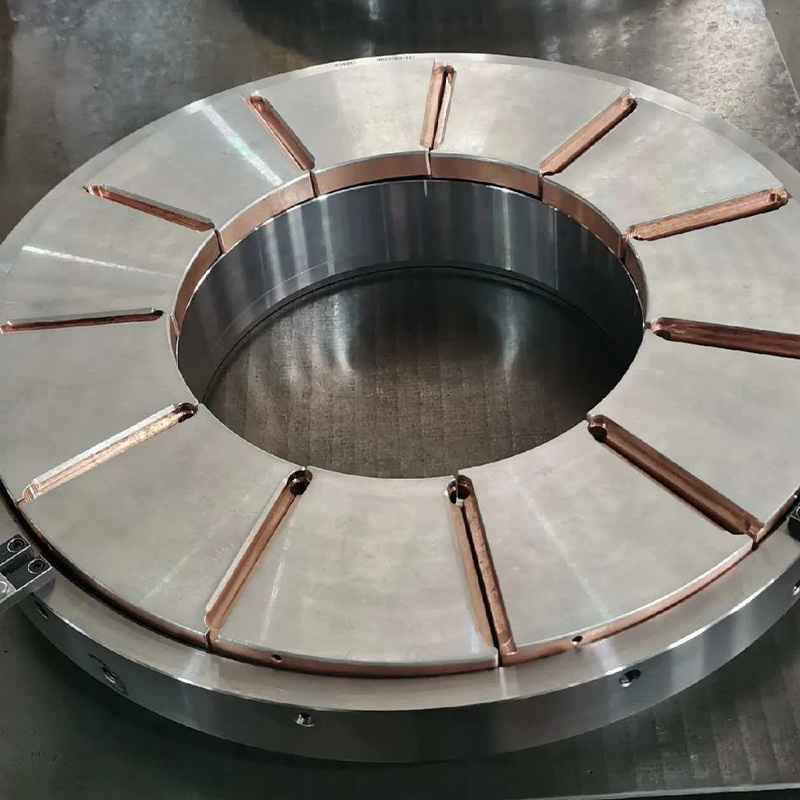
At the most fundamental structural level, these two bearing types manage kinetic friction in completely different ways. A Babbitt Bearing operates primarily on the proven principle of hydrodynamic fluid lubrication. As the heavy steel shaft begins to rotate, it physically pulls viscous oil into a microscopic converging clearance space. This continuous rotational pumping action generates an immensely high-pressure fluid wedge. The resulting pressurized wedge physically lifts the entire rotating shaft off the metal surface. It entirely prevents destructive metal-to-metal contact during normal continuous operation. The liquid oil itself becomes the actual load-bearing element.
Conversely, standardized roller bearings rely entirely on mechanical rolling friction dynamics. They utilize precisely machined metallic rolling elements to physically separate the inner and outer raceways. These highly engineered elements usually consist of hardened steel balls, cylindrical rollers, or tapered rollers. They physically roll along a constrained track as the machinery operates. This constant mechanical separation drastically reduces overall rotational friction without requiring a pressurized fluid wedge.
Contact geometry highlights the most profound structural contrast between the two designs. Hydrodynamic fluid-film designs provide continuous, virtually infinite surface-area support along the entire length of the journal. The fluid evenly distributes massive mechanical loads across a massive physical footprint. Rolling elements act entirely differently. They concentrate extreme rotational forces onto tiny, highly localized contact points or extremely narrow contact lines. This localized pressure inevitably leads to completely different long-term fatigue profiles and failure modes.
High-speed industrial equipment demands exceptional operational stability and unwavering continuous support. A Babbitt Bearing thrives uniquely in these intense, continuous operational environments.
Hydrodynamic lift fundamentally strengthens as rotational speed increases. Higher RPMs generate significantly greater oil wedge pressure inside the housing. This distinct physical phenomenon makes them ideal components for massive power generators, centrifugal compressors, and steam turbines. They easily carry multi-ton rotor loads safely at many thousands of RPMs. The faster the shaft spins, the stronger the protective oil film essentially becomes.
The pressurized oil film also provides truly unparalleled vibration dampening capabilities. It acts as a massive, continuously adaptive hydraulic shock absorber. This specialized fluid layer effectively isolates the spinning shaft from the rigid machine housing. Engineers heavily value these specific shock-absorption benefits:
It actively dampens severe transient loads during initial motor startup sequences.
It effectively isolates harsh gear meshing vibrations from the rigid machine casing.
It prevents catastrophic harmonic resonance from instantly tearing sensitive equipment apart.
Specialized metallurgy plays a highly crucial defensive role here. The deliberately soft alloy safely absorbs microscopic metallic debris and ambient dirt. Engineers formally call this property "embeddability." It also easily conforms to minor shaft misalignments over time. The soft alloy surface intentionally sacrifices itself to protect the highly expensive, perfectly machined steel rotor.
In-place serviceability remains a massive operational advantage for large-scale industrial facilities. Maintenance crews can often carefully scrape or pour a new bearing directly on-site. They completely avoid removing massive, multi-ton shafts from the congested machine floor. This unique capability routinely saves weeks of potential operational downtime.
Roller bearings genuinely shine under completely different dynamic mechanical conditions. They easily outclass traditional fluid-film designs during frequent start-stop machinery operations.
They uniquely maintain incredibly low starting friction even at absolute zero RPM. When a fluid-film unit stops spinning completely, the supportive oil wedge instantly collapses. This sudden collapse causes momentary boundary lubrication. It means raw metal physically rubs against raw metal during the initial rotational spin-up phase. Roller elements completely bypass this vulnerability. They roll instantly upon startup without relying on gradually built-up fluid pressure.
They also manage highly complex directional mechanical forces incredibly efficiently. Specialized tapered or spherical roller bearings handle combined radial and axial thrust loads simultaneously. They accomplish this impressive dual-load management within a remarkably compact physical footprint. You rarely need massive, separate thrust collars when deploying highly engineered tapered rolling elements.
Global component standardization heavily favors rolling element designs today. Procurement teams routinely buy them as readily available, off-the-shelf catalog components. Installing them securely requires very standard mechanical maintenance skills. Facilities completely eliminate the complex need for specialized pouring metallurgy or traditional hand-scraping expertise. You simply utilize a hydraulic press to push out the old unit and securely press in the new one. This modular predictability severely cuts down routine maintenance turnaround times.
Choosing the correct rotating component strictly requires a highly objective evaluation framework. Engineers must carefully weigh standard operational speeds, lubrication systems, and physical space limits. You cannot guess when specifying critical heavy machinery components.
Operating speed defines your initial baseline criteria. You must accurately assess your standard, everyday rotational RPM. Equipment running continuously at very high speeds heavily favors a hydrodynamic design. Machinery frequently subjected to highly variable speeds, reversing loads, or very slow rotations strictly requires rolling elements to avoid excessive wear.
Lubrication infrastructure represents a major permanent facility commitment. Large fluid-film applications demand highly complex, fully pressurized oil delivery systems. They also require continuous external cooling mechanisms to safely manage extreme viscous friction heat. Conversely, rolling elements typically utilize much simpler sealed grease packs or highly basic static oil baths. They require vastly less supporting fluid infrastructure.
Physical space and absolute weight constraints frequently force an engineer's hand early. Standardized roller bearing assemblies typically require much less physical physical space for the exact same shaft diameter. This highly compact nature significantly impacts overall housing design. It allows engineers to design much lighter, smaller surrounding machinery casings.
Long-term failure modes strongly dictate facility condition monitoring strategies. Rolling elements usually experience highly sudden, often catastrophic mechanical failures like severe spalling or sudden cage seizure. A traditional Babbitt Bearing degrades much more predictably and gradually. It offers very clear, highly detectable warning signs like incremental temperature spikes or subtle vibration increases long before catastrophic failure occurs.
| Evaluation Criteria | Babbitt Bearings | Roller Bearings |
|---|---|---|
| Standard Operating Speed | Highly excellent for continuous, extreme high RPM | Highly excellent for very low, variable RPM |
| Lubrication System Needs | Highly complex, continuous pressurized oil circulation | Highly simple sealed grease or static oil bath |
| Physical Space Requirements | Generally requires a much larger housing footprint | Offers a highly compact, standardized design |
| Typical Expected Failure Mode | Predictable gradual wear, highly detectable early | Sudden fatigue spalling or total cage seizure |
Engineers frequently search forums asking about permanently swapping one distinct bearing type for another. Retrofitting rotating equipment carries severely significant mechanical risks. You cannot simply drop a modern modular unit into a legacy housing without major consequences.
Converting a legacy system from fluid-film to rolling elements drastically alters delicate system harmonics. The rotating shaft permanently loses its natural hydraulic shock absorber. This complex modification often requires highly extensive precision shaft machining. You must also successfully fabricate completely new, custom housing adapters. These profound structural changes frequently introduce completely unexpected resonance frequencies into the high-speed rotating assembly. It often causes sudden, severe fatigue failures elsewhere in the drive train.
We strongly recommend using a definitive shortlisting logic to firmly guide your daily engineering specifications. Consider strictly applying these actionable, real-world engineering rules when making your final decision:
Assess rotational continuity carefully. If the equipment runs non-stop continuously at high speeds, strictly choose fluid-film designs.
Analyze your daily start-stop frequency. If the shaft stops frequently during shifts, immediately choose rolling elements to strictly avoid boundary friction wear.
Evaluate internal maintenance capabilities honestly. If you completely lack specialized hand-scraping labor, strongly rely on standardized modular roller units.
Review your operational failure tolerance. If you absolutely need early warning diagnostic signs before complete failure, utilize the highly gradual wear characteristics of a Babbitt Bearing.
Neither individual bearing technology proves universally superior across every single industrial application. The optimal engineering choice hinges entirely on your specific load continuity, typical rotational speeds, and available facility maintenance infrastructure. Engineers must strictly align component selection with their exact operational realities. Relying solely on outdated assumptions leads to expensive premature machinery failures.
The final assessment rule remains highly straightforward for modern plant managers. If your critical heavy equipment runs constantly at high speeds and extreme loads, invest heavily in a Babbitt Bearing. The inherent hydrodynamic stability provides truly unmatched longevity. Conversely, if the machine constantly starts and stops frequently, or if your facility completely lacks specialized metallurgical support, roller bearings definitely represent a much safer, modular bet.
Take immediate professional action to safely safeguard your expensive rotating assets. Consult directly with a dedicated mechanical bearing engineering specialist today. Request a highly comprehensive, custom load-and-speed application review. Proactively secure a professional engineering evaluation to guarantee your facility equipment runs smoothly and safely for decades.
A: The soft alloy never actually supports the heavy shaft during continuous operation. It relies entirely on a pressurized hydrodynamic oil wedge. The highly pressurized fluid film physically carries the massive load. The soft metal intentionally acts as a sacrificial safety layer. It cleanly embeds foreign dirt particles and effectively protects the expensive steel rotor from catastrophic scoring.
A: Yes, but it firmly requires highly complex engineering. You cannot perform a direct, simple drop-in swap. The mechanical conversion demands extensive custom housing modifications and precision shaft machining. Furthermore, replacing a Babbitt Bearing with rolling elements completely eliminates natural hydraulic shock absorption. This frequently increases highly damaging system vibrations.
A: Absolutely not. They remain completely irreplaceable in modern heavy industrial applications. While modular rolling elements heavily dominate smaller commercial goods, massive power generation turbines, large industrial compressors, and high-speed marine drives still rely entirely on proven fluid-film technology for infinite lifespan operational capabilities.
A: Trained technicians rely heavily on objective condition monitoring tools. Sudden or creeping spikes in continuous operational oil temperatures provide the very first warning. Operators will also closely notice steadily increasing vibration signatures on their diagnostic sensors. Finally, finding shiny, microscopic metallic debris directly inside the primary oil filters clearly confirms severe physical wear.


