
Views: 0 Author: Site Editor Publish Time: 2026-05-12 Origin: Site
A tilting pad bearing is used in rotating machinery where stable shaft support, predictable oil-film behavior, and controlled rotor dynamics are important. Instead of relying on one continuous fixed bearing surface, the design uses several pads that can pivot through small angles as the shaft or thrust collar moves. Each loaded pad develops its own hydrodynamic pressure field, allowing the bearing to respond to changes in speed, load, temperature, and shaft position.
This architecture is common in turbines, centrifugal compressors, generators, pumps, gearboxes, and other machinery where bearing behavior can influence vibration and rotor stability. It is not automatically superior to every fixed-profile bearing, however. The correct choice depends on the machine operating envelope, bearing load, lubricant conditions, shaft dynamics, available space, and maintenance requirements.
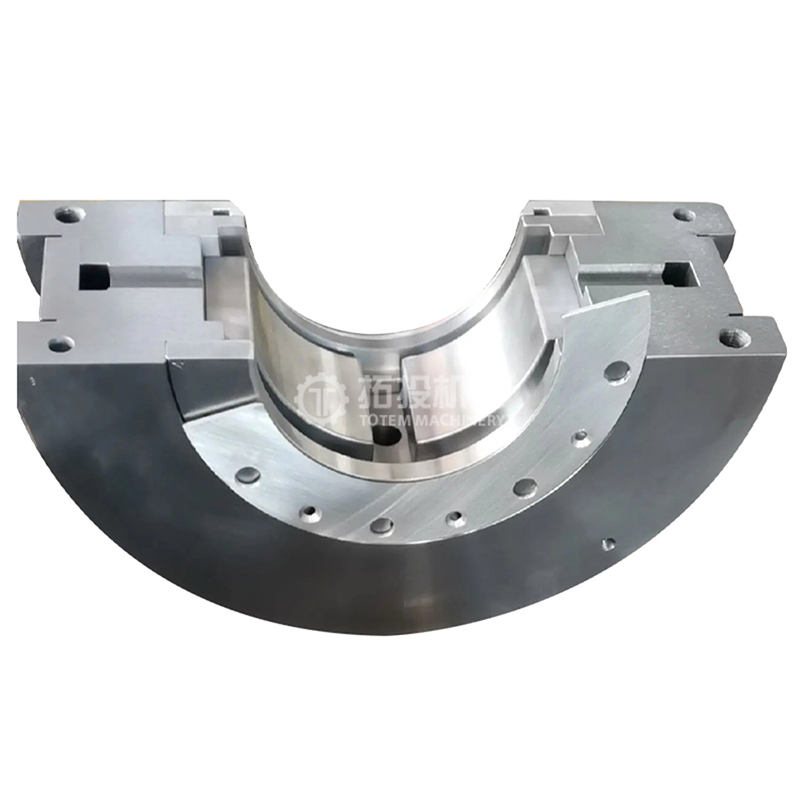
A tilting pad bearing is a type of hydrodynamic fluid-film bearing made from several individual bearing pads supported on pivots. Relative motion between the rotating surface and the lubricant draws oil into a converging clearance, producing pressure that separates the moving surfaces during normal hydrodynamic operation. The pads are free to establish small angular positions rather than remaining part of one rigid cylindrical or flat profile.
A typical white metal bearing may use a steel backing with a Babbitt running surface because the lining provides a suitable interface for hydrodynamic operation and can accommodate the specific design requirements of large rotating equipment. Tilting-pad designs add the pivoting mechanism needed for each segment to respond independently. Manufacturers such as Waukesha and Michell likewise describe tilting-pad bearings as segmented hydrodynamic bearings used in journal and thrust arrangements.
The most important distinction is therefore not simply the bearing material. Geometry, pivot design, clearance, lubricant delivery, pad loading, and the rotor system around the bearing all influence how it performs.
Hydrodynamic lubrication depends on relative surface motion, lubricant viscosity, load, and a converging film geometry. As the journal rotates, lubricant is drawn into the space between the shaft and a loaded pad. Pressure rises within the converging region and creates a load-supporting oil film.
A tilting pad bearing allows each segment to rotate slightly about its pivot until the pad reaches an operating attitude determined by the local forces acting on it. This movement helps establish separate hydrodynamic wedges rather than one continuous pressure field around a fixed bearing profile. The resulting film thickness and pad temperature still depend on operating conditions, so pad movement should not be interpreted as automatic compensation for every lubrication or alignment problem.
Oil supply is equally important. Insufficient flow, unsuitable viscosity, excessive inlet temperature, restricted drainage, or hot-oil carryover can affect film thickness and thermal behavior even when the bearing geometry itself is correct. For this reason, hydrodynamic bearing design and lubrication-system design need to be evaluated together.
Fixed-profile journal bearings can operate reliably in many machines, but certain combinations of speed, load, clearance, lubricant properties, and rotor characteristics can produce destabilizing cross-coupled fluid forces. These forces may contribute to subsynchronous vibration such as oil whirl and, under unfavorable rotor-dynamic conditions, oil whip.
A tilting pad journal bearing changes that dynamic behavior because each pad develops a more localized pressure field. Independent pad motion can substantially reduce destabilizing cross-coupled stiffness compared with some fixed-geometry journal bearing arrangements. The effect improves the stability margin available to rotor designers, particularly in equipment where fluid-film dynamics are important.
This does not mean the bearing eliminates every source of vibration. Rotor imbalance, misalignment, structural resonance, unsuitable clearance, incorrect preload, damaged pivots, poor lubrication, and foundation problems can still cause unstable or unacceptable machine behavior. Bearing selection must therefore remain part of a complete rotordynamic assessment.
A tilting pad design can support either radial or axial load, depending on how the pads are arranged. Journal bearings surround the shaft and primarily control radial position, while thrust bearings act against a thrust collar or runner to control axial movement. Many large machines use both functions within the same shaft system.
| Bearing Type | Main Load | Primary Function | Typical Equipment |
|---|---|---|---|
| Tilting pad journal bearing | Radial | Supports the shaft and influences rotor stiffness and damping | Compressors, turbines, generators, pumps, gearboxes |
| Tilting pad thrust bearing | Axial | Controls axial position and transmits thrust into the support structure | Turbines, compressors, pumps, marine propulsion |
| Combined arrangement | Radial and axial | Provides separate radial support and thrust control within one machine system | Turbomachinery and other complex rotating systems |
A journal design normally uses several pads distributed around the shaft. Four- and five-pad arrangements are common, although pad number and load orientation remain application-specific rather than universal design rules. Waukesha similarly identifies pad number, preload, pivot offset, clearance, and load orientation as variables that can be changed to suit the machine.
In a thrust assembly, each pad forms a hydrodynamic wedge against the rotating collar. A Babbitt thrust pad can therefore form part of a larger bearing system that includes a base ring, support arrangement, lubricant supply, and load-equalizing features where required. TOTEM's product range includes thrust pads designed for tilting-pad thrust bearing assemblies.
Neither bearing architecture should be described as universally better. Fixed-profile bearings remain practical where speed, load, operating range, and rotor dynamics are compatible with their characteristics. A tilting pad bearing becomes particularly valuable when stability requirements or changing operating conditions justify a more configurable fluid-film design.
| Factor | Fixed-Profile Bearing | Tilting Pad Bearing |
|---|---|---|
| Rotor-dynamic behavior | Can perform reliably within an appropriate operating range but may develop stronger cross-coupled effects in some high-speed systems | Usually provides lower destabilizing cross-coupling and greater design flexibility |
| Geometry | Continuous fixed profile | Multiple independently pivoting pads |
| Design complexity | Generally simpler | More components and more design variables |
| Misalignment response | Depends strongly on bearing geometry and machine alignment | Individual pad motion can accommodate moderate changes in shaft attitude |
| Engineering flexibility | More limited geometric tuning | Clearance, preload, pivot, pad number, and orientation can be adjusted |
| Lubrication requirements | Application dependent | Oil distribution and pad thermal behavior require careful evaluation |
| Best use case | Stable loads and operating conditions within the bearing's design envelope | Machinery where rotor stability or variable operating conditions justify additional complexity |
The practical selection question is not whether a modern design should replace an older one. Engineers should determine which bearing characteristics the rotor actually needs and whether the expected improvement justifies the additional manufacturing, lubrication, monitoring, and maintenance requirements.
Performance comes from the interaction of several variables rather than one preferred configuration. Changing clearance, preload, pivot location, or lubrication can alter minimum film thickness, pad temperature, stiffness, damping, and power loss at the same time. For that reason, a design optimized for one machine should not be copied directly into another.
| Design Variable | Why It Matters | Engineering Consideration |
|---|---|---|
| Bearing clearance | Influences oil-film thickness, temperature, stiffness, and dynamic coefficients | Must reflect shaft size, speed, load, oil properties, and thermal condition |
| Preload | Changes pad-film geometry and bearing dynamic characteristics | Neither zero nor high preload is universally preferable |
| Pivot location | Influences pad attitude, pressure distribution, and directionality | Centered or offset arrangements should match rotation and design requirements |
| Pad number and orientation | Changes load distribution and stiffness characteristics | Four- and five-pad journal arrangements are common, but selection is application-specific |
| Lubricant supply | Controls heat removal and hydrodynamic film formation | Oil flow, viscosity, inlet temperature, supply method, and drainage require review |
| Pad material and lining | Affects running-surface behavior, manufacturability, and repair strategy | Material specification should follow machine requirements and approved drawings |
Clearance is one of the most sensitive dimensions in a fluid-film bearing. Excessive clearance may alter dynamic coefficients and reduce the intended control of shaft motion, while insufficient clearance can restrict oil-film development and increase thermal sensitivity. The correct assembled value must account for actual shaft and housing dimensions rather than nominal dimensions alone.
Preload modifies the relationship between pad curvature and assembled bearing geometry. Lower preload may provide favorable stability characteristics in some systems, while a different value may be selected to achieve the required stiffness, film behavior, or pad control elsewhere. It should therefore be established through hydrodynamic, thermal, and rotordynamic analysis rather than treated as a universal setting.
A pivot provides the support about which each pad establishes its operating angle. Center pivots can suit bidirectional requirements in appropriate designs, while offset pivots may be selected when rotation is defined and the pressure distribution benefits from an asymmetric pivot position. Pivot type and flexibility may also influence the dynamic response of the complete assembly.
Load-on-pad and load-between-pad orientations offer another design choice in journal bearings. Their effects depend on the number of pads, bearing load direction, rotor stiffness, and required dynamic coefficients. Selection should follow system-level calculations instead of a generic rule.
Reliable hydrodynamic operation depends on more than supplying oil to the bearing housing. The lubricant must reach the pad surfaces under suitable pressure, viscosity, temperature, and flow conditions, then leave the bearing without excessive recirculation. Oil distribution can influence both minimum film thickness and pad metal temperature.
Some bearing designs use flooded lubrication, while others direct oil more specifically toward the pad inlet regions. Directed lubrication can reduce unnecessary oil recirculation and may change power loss or temperature behavior, but the appropriate arrangement depends on the bearing and machine design. Waukesha, for example, treats directed lubrication, pad geometry, and operating conditions as related design considerations rather than independent features.
During a retrofit, the existing oil system should not be assumed to be suitable automatically. Supply passages, drain capacity, oil temperature, filtration, instrumentation, and housing geometry need to be reviewed together before changing the bearing configuration.
The most useful way to understand tilting pad bearing applications is to identify the mechanical problem being solved. High rotational speed is a common reason, but it is not the only one. Heavy axial thrust, rotor flexibility, changing operating conditions, thermal growth, and demanding reliability requirements can also influence the decision.
Steam and gas turbine rotors require controlled radial support while thrust bearings maintain axial rotor position. Temperature changes, shaft-line movement, pressure forces, and strict vibration limits can make bearing dynamic behavior especially important. A tilting pad journal bearing may be used for radial stability, while a thrust arrangement manages axial loads.
The bearing must still be considered alongside the rest of the steam turbine parts, including the rotor shaft, casing, shaft seals, and support structure. TOTEM's turbine product category includes rotor shafts, thrust bearings, sleeve bearings, and tilting-pad bearing components for turbine applications.
Centrifugal compressor rotors may operate across changing process conditions and can be sensitive to subsynchronous vibration. A configurable journal bearing can help designers obtain appropriate stiffness and damping while a separate thrust bearing manages axial forces generated across compressor stages.
Pumps and gearboxes present different load systems but can raise similar questions about radial loading, axial thrust, shaft flexibility, temperature, and vibration. A tilting pad bearing is justified where these operating requirements produce a clear engineering benefit; simpler bearing arrangements may remain appropriate in less demanding machines.
Marine propulsion systems can generate substantial axial thrust that must be transmitted from the shaft line into the ship structure. Tilting-pad thrust bearings may be used where stable oil-film operation and controlled axial positioning are required. Shaft alignment, hull deflection, bearing reactions, lubricant condition, and propulsion load remain part of the same system-level assessment.
Large hydroelectric machines provide another example where speed alone is an incomplete selection criterion. Heavy rotor or runner loads and vertical shaft arrangements can make load capacity and oil-film behavior as important as rotational speed.
Selection should begin with the machine rather than the bearing catalog. Engineers normally need to define shaft diameter, rotational speed range, radial load, axial thrust where applicable, rotation direction, lubricant properties, inlet oil condition, bearing housing geometry, shaft alignment, thermal growth, and known rotor-dynamic requirements.
Existing equipment should also be reviewed for vibration history, bearing temperatures, startup and shutdown behavior, oil condition, shaft journal condition, and previous bearing distress. These observations help distinguish a genuine bearing-design problem from imbalance, resonance, misalignment, lubrication deficiency, or another system fault.
For a retrofit, replacing a fixed-profile bearing with a tilting pad bearing should follow a rotordynamic and mechanical compatibility review. Housing envelope, oil connections, drains, probes, shaft position, installation access, and operating transients may all affect whether the conversion is practical.
Bearing performance depends on whether the manufactured component reproduces the intended geometry. A white metal tilting pad may require control of pad thickness, inner radius, pivot location, lining integrity, surface finish, and oil-groove geometry. Errors in these features can change the actual clearance or hydrodynamic surface from the design condition.
TOTEM describes a manufacturing route that includes steel backing preparation, Babbitt lining, precision machining, dimensional inspection, and examination of the bonded white-metal layer. Its product information also identifies coordinate measuring equipment, ultrasonic examination of Babbitt bonding, surface-roughness checks, and oil-groove inspection among the available inspection steps.
Inspection requirements should still follow the approved drawing, customer specification, and applicable project documentation. Generic numerical tolerances should not be substituted for machine-specific requirements, particularly when producing replacement pads for an existing bearing assembly.
Commissioning should establish a baseline rather than simply confirm that the machine can rotate. Bearing temperature, shaft vibration, shaft position where monitored, lubricant inlet and outlet conditions, and operating load should be observed across the approved operating range. Startup, coast-down, and process transitions may reveal behavior that is not apparent at one steady-state condition.
| Symptom | Possible Bearing-Related Causes | Checks to Consider |
|---|---|---|
| Rising pad temperature | Oil-flow restriction, unsuitable clearance, excessive load, hot-oil carryover, surface distress | Verify oil conditions, temperature pattern, load, clearance, and pad surface |
| Subsynchronous vibration | Bearing dynamic characteristics, excessive clearance, rotor interaction | Review spectrum, speed dependence, shaft orbit, rotor model, and bearing condition |
| Localized Babbitt damage | Edge loading, lubrication loss, contamination, geometry error | Inspect pad surface, pivot, journal, oil supply, alignment, and dimensions |
| Unstable temperature after retrofit | Oil distribution, altered loading, housing or drainage limitations | Compare with commissioning baseline and inspect the complete lubrication path |
A symptom should not be treated as proof of one failure mechanism. Bearing temperature, for example, can change because of load, oil viscosity, supply temperature, clearance, alignment, or changes elsewhere in the machine. Effective troubleshooting connects inspection evidence with operating data before repair or replacement decisions are made.
A tilting pad bearing provides a configurable hydrodynamic support system for machinery where rotor stability, controlled load transmission, and reliable oil-film behavior are important. Its performance depends on the complete combination of clearance, preload, pivot geometry, pad arrangement, lubrication, material condition, and rotor dynamics rather than on the bearing type alone. Journal and thrust designs serve different load directions, while careful manufacturing and inspection help preserve the geometry assumed during engineering design. Selection should therefore begin with actual machine loads and operating conditions, followed by system-level analysis and verified manufacturing requirements.
Its principal advantage is improved control of fluid-film dynamics. Independent pads can substantially reduce destabilizing cross-coupled effects while giving engineers additional control over stiffness, damping, clearance, preload, and load orientation.
It can greatly reduce the fluid-film mechanism that contributes to oil-whirl instability compared with some fixed-profile journal bearings, but it does not guarantee a vibration-free rotor. Overall behavior still depends on the rotor, bearing geometry, alignment, lubrication, structure, and operating conditions.
Four- and five-pad configurations are common, although other arrangements can be engineered for specific applications. Pad number should be selected together with load orientation, clearance, preload, pivot design, rotor dynamics, and thermal requirements rather than by a fixed industry rule.
A tilting pad journal bearing primarily supports radial shaft loads and influences lateral rotor dynamics. A tilting pad thrust bearing carries axial load against a thrust collar or runner and controls the shaft's axial position.
Important inputs include shaft and housing dimensions, speed range, load, rotation direction, lubricant specification, operating temperature, required clearance, pad geometry, pivot configuration, and relevant machine drawings. For a retrofit or recurring failure, vibration history, journal condition, alignment information, and previous inspection results are also valuable.
Not necessarily. A retrofit may require changes to the housing, lubrication passages, drainage, instrumentation, or bearing geometry, and the resulting rotor-dynamic characteristics need to be evaluated before installation.


