
Views: 0 Author: Site Editor Publish Time: 2026-05-16 Origin: Site
Traditional fixed-geometry bearings eventually hit a hard physical limit in high-speed rotating machinery. As operational speeds climb past 6,000 RPM, engineers routinely face destructive oil whirl, rapid thermal breakdown, and crippling misalignment issues. These constraints put mission-critical equipment, like gas compressors and steam turbines, at severe risk of catastrophic failure. Finding a reliable way to stabilize rotor dynamics without sacrificing mechanical efficiency is critical for modern industrial operations.
Upgrading to a more adaptive mechanical solution becomes essential to meet strict API compliance and prevent sudden equipment trips. This guide explores how the Tilting pad bearing delivers predictable dampening and measured thermal control in demanding applications. You will learn the core kinematics, explore key design variables, and understand the practical retrofit realities needed to break the high-speed barrier safely.
Mechanism: Individual pads pivot independently to create a self-sustaining hydrodynamic wedge, eliminating the cross-coupled stiffness that causes oil whirl.
Performance: Safely elevates equipment running speeds from ~6,000 RPM to 14,000+ RPM while maintaining rotor stability.
Thermal Control: Advanced designs (like directed lubrication and leading-edge grooves) reduce parasitic power loss and cut maximum metal temperatures significantly compared to flooded systems.
Retrofit Viability: Upgrading requires a holistic system review—accounting for existing oil flow capacities, space constraints, and rotordynamic analysis—not just a simple parts swap.
Engineers have long relied on cylindrical or elliptical fixed-profile bearings for general industrial machinery. They work well at moderate speeds. However, as rotor velocities increase, fixed clearances create a dangerous aerodynamic and fluid phenomenon known as cross-coupled stiffness.
When a shaft rotates inside a fixed bearing, it drags lubricating oil into a converging wedge. This action generates high fluid pressure to support the rotor. If an external force disturbs the shaft, the oil film pushes back. In a fixed bearing, this reactionary force pushes at an angle perpendicular to the disturbance. We call this cross-coupled stiffness. At high speeds, these perpendicular forces drive the shaft into a violent, self-exciting orbit known as oil whirl. If the whirl frequency matches the machine’s critical speed, catastrophic rotor vibration destroys the equipment.
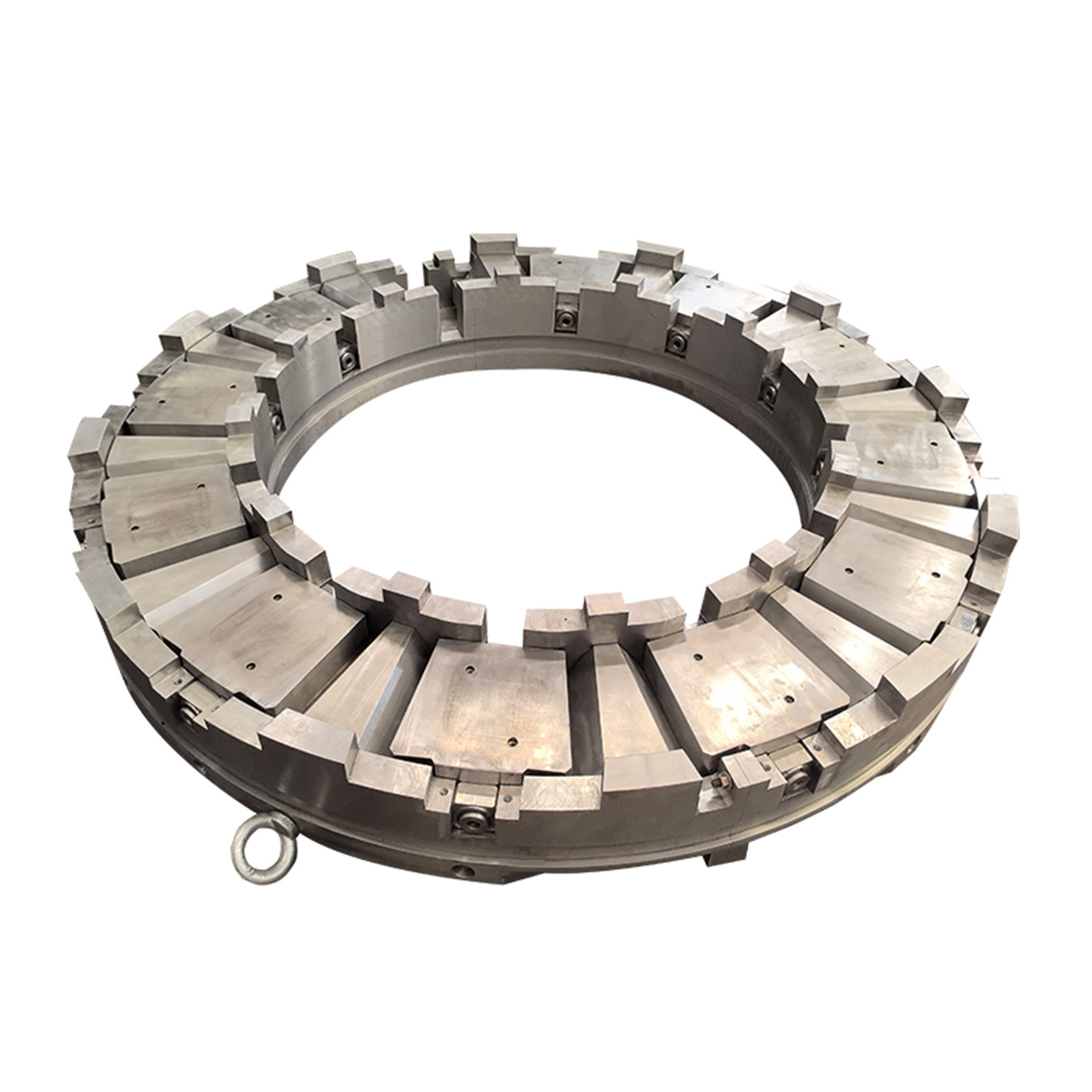
Tilting pad bearings solve this instability through adaptive kinematics. Rather than a solid ring, the bearing assembly features several distinct components: a rigid outer housing, a rotating journal shaft, pivot pins, and individual tilting pads.
Instead of forcing the oil film into a fixed geometry, each pad pivots on its underlying pin. As the shaft’s load and speed fluctuate, the pads independently rock back and forth. They find their own optimal equilibrium. Because the pads continuously align themselves to the shaft surface, the high-pressure oil wedge always points directly toward the center of the journal. This dynamic movement effectively neutralizes destabilizing cross-forces. By eliminating cross-coupled stiffness, the system suppresses oil whirl and unlocks predictable dampening at speeds exceeding 14,000 RPM.
While radial bearings handle lateral forces, thrust bearings manage axial loads. Tilting pad thrust bearings introduce an additional mechanical advantage: self-equalizing leveling links.
Angular misalignment occurs frequently due to thermal expansion or foundation settling. Fixed thrust bearings cannot adapt to this skew, causing localized overloading on a single side of the bearing face. Self-equalizing tilting pads sit on an interconnected network of mechanical levers. If the shaft skews and presses hard against one pad, the underlying link pushes down. This action forces the opposite link to push its corresponding pad up. The mechanism passively adapts to angular misalignment, ensuring the load distributes evenly across all pads. Many rigorous API standards mandate this exact design for heavy-duty process compressors.
Specifying a tilting pad bearing requires careful calibration of internal geometry. Minor adjustments significantly impact load capacity versus system stability. Engineers must evaluate three critical variables.
The pivot point dictates how a pad tilts. If we place the pivot exactly in the middle of the pad arc, we call it a center pivot (0.5 offset). Center pivots allow the shaft to run equally well in both rotational directions.
However, shifting the pivot slightly downstream towards the trailing edge—typically an offset between 0.55 and 0.60—forces the leading edge to open wider. This asymmetrical geometry scoops more cool oil into the gap and builds a thicker, stronger hydrodynamic wedge. An offset pivot significantly increases the overall load-carrying capacity and improves hydrodynamic lift, though it restricts the machine to unidirectional rotation.
Preload measures the geometric relationship between the overall bearing assembly clearance and the individual pad clearance. Engineers typically express it as a ratio, with 0.3 being a common industrial standard.
Adjusting preload forces a strict trade-off between stiffness and dampening. Consider the following implementation risks:
High Preload: The pads closely hug the shaft. This tight convergence increases system stiffness, making it excellent for stabilizing extremely light rotors operating at high speeds.
Zero Preload: The pad curvature matches the bearing curvature. This configuration maximizes mechanical dampening, absorbing heavy vibrations.
Common Mistake: Specifying zero preload introduces severe operational risks. Due to standard machining tolerances, a targeted zero preload can easily become a negative preload during manufacturing. Furthermore, in lightly loaded applications, zero preload often causes the top, unloaded pads to flutter violently against the shaft, leading to rapid babbitt fatigue.
How the pads align relative to the primary gravitational or applied load changes the bearing's dynamic profile. We categorize orientation into two standard setups.
| Orientation | Description | Primary Benefit | Best Application |
|---|---|---|---|
| Load On Pad (LOP) | The main load vector points directly into the center of a single bottom pad. | Provides superior symmetrical stiffness and maximizes rotor stability. | High-speed, light-load machines requiring maximum dampening against vibration. |
| Load Between Pads (LBP) | The main load vector points evenly between two adjacent bottom pads. | Increases ultimate load-carrying capacity by utilizing two load-bearing surfaces. | Heavy, massive rotors requiring strong hydrodynamic lift. |
At surface velocities pushing 100 meters per second, managing thermal breakdown becomes the primary engineering challenge. You must protect the babbitt metal lining from melting.
You might assume most bearing heat comes directly from shaft friction. In reality, up to 60% of bearing heat generates from hot oil carryover. As oil passes under one pad, it heats up under immense shear pressure. When it exits the trailing edge, it drags directly into the leading edge of the next pad. The second pad ingests hot fluid, increasing its baseline temperature.
Engineers monitor these temperatures relentlessly. Most industrial operators target a design threshold of 185°F (85°C). They set the system alarm at 230°F (110°C) and program an automatic machine trip at 250°F (121°C) to prevent the babbitt from turning soft and smearing against the steel journal.
Mitigating carryover requires choosing the right oil delivery method.
Flooded Lubrication: Standard systems flood the entire bearing housing with pressurized oil. The pads remain completely submerged. This method is simple, reliable, and highly effective at lower rotational speeds. However, as speeds increase, the submerged components act like an eggbeater in a mixing bowl. Churning the excess oil creates massive parasitic power loss and generates tremendous external heat.
Directed Lubrication: When sliding speeds exceed 50 meters per second, engineers abandon flooded housings. Instead, they use directed lubrication. Technologies like Leading Edge Grooves (LEG) or spray bars inject cool, pressurized oil directly into the gap just before the pad's leading edge. This specific injection blocks the hot carryover oil from entering the wedge. It also allows the housing to remain mostly empty, slashing parasitic power loss by up to 50% and dramatically lowering pad temperatures.
When bearings run hot, operators often try a seemingly logical fix: pump more oil into the system. This instinct frequently backfires due to complex fluid dynamics within the transition zone.
Inside the bearing gap, oil behaves based on its Reynolds number. Above a Reynolds number of roughly 1000, the oil flow turns turbulent. Turbulent flow is highly conductive; it aggressively pulls heat away from the pad surface. If you pump more cool oil into the system, you increase the fluid's overall viscosity. Thicker oil drops the Reynolds number back below 1000, shifting the flow from turbulent to laminar. Laminar flow acts like a thermal insulator. Consequently, pumping more oil traps heat against the metal surface, actively decreasing cooling efficiency and causing pad temperatures to spike.
Selecting the right bearing geometry requires analyzing the operational environment. Tilting pads provide massive benefits, but they are not universally required for every machine.
Fixed geometry bearings remain highly relevant. They cost less to manufacture and involve fewer moving parts. You should retain fixed bearings in scenarios involving:
Constant rotational speeds operating well below the first critical speed threshold.
Steady, predictable loads with minimal process gas fluctuations.
Highly controlled environments where foundation shifting or angular misalignment is practically non-existent.
Lower RPM industrial pumps, industrial fans, and smaller electric motors.
Conversely, specific industrial environments demand the adaptive nature of tilting pads. Engineers must specify this technology when designing or retrofitting:
High-speed, variable-load applications, such as steam turbines and multi-stage gas compressors.
Machines that frequently cross multiple critical speed thresholds during startup and coast-down phases.
Environments prone to severe thermal expansion, pipe strain, or foundation shifting where high misalignment tolerance is an absolute necessity.
Systems suffering from persistent, unexplained rotor vibration that standard balancing cannot resolve.
Deciding to upgrade a problem machine from fixed geometry to a tilting pad design involves complex engineering. It is never a simple parts swap. Buyers considering an upgrade must follow a strict, pragmatic checklist to ensure system compatibility.
Clearance & Envelope Constraints: First, you must confirm physical housing interchangeability. Tilting pads require more radial space for pivot pins and support blocks. Verify the existing machine casing can safely support these complex pivot structures without compromising structural integrity.
Lube Oil System Capacity: Adopting directed lubrication or modifying preload will alter your baseline oil flow requirements. Upgraded bearings often require different operating pressures. You must validate existing pumps, filters, and coolers. Ensure they can handle the revised flow rates without starving other critical components.
Hydrostatic Jacking Requirements: Heavy rotors face immense friction at startup before rotational speed can build a hydrodynamic wedge. Tilting pad thrust bearings generally only yield about 60% of their maximum load capacity at zero RPM. Therefore, heavy applications often necessitate adding a high-pressure (100–150 bar) hydrostatic lift system. This system injects oil directly under the pads, floating the rotor to prevent dry scraping during initial rotation.
Rotordynamic Audit: You cannot guess stability. Emphasize predictive software analysis. Before cutting metal, engineers must run the new bearing parameters through rotordynamic software like DyRoBeS. This audit verifies dampening coefficients and confirms you are not accidentally shifting the rotor's critical speeds directly into your normal operating ranges.
Tilting pad bearings remain the definitive, mathematically proven solution for resolving high-speed dynamic instability and overcoming severe thermal limitations. They are not a universal necessity for every rotating asset on your plant floor. However, when traditional fixed bearings hit their operational ceilings, tilting pads provide the mechanical adaptability required to push equipment safely past 14,000 RPM while resisting catastrophic oil whirl.
Your next step requires data-driven action. Encourage your reliability managers and rotating equipment engineers to conduct a comprehensive rotordynamic audit on your most problematic machines. Identify assets suffering from chronic vibration or thermal alarms. Consult with a specialized bearing manufacturer to model a custom pad geometry, and use predictive software to validate the retrofit before committing to hardware modifications.
A: Maximum speed depends heavily on surface sliding velocity rather than just RPM. Engineers typically cap conventional babbitt-lined tilting pads around 300 feet per second (90 m/s). Advanced polymer-lined pads paired with directed lubrication can safely push beyond these limits, significantly raising the thermal threshold before material degradation occurs.
A: Yes, but only if they utilize a center-pivot design (0.5 offset). Center pivots provide symmetrical oil wedges for bi-directional rotation. Conversely, offset-pivot designs optimize hydrodynamic lift and load capacity for one specific direction, making them strictly uni-directional.
A: Pad flutter typically occurs in lightly loaded machines using a zero-preload configuration. Without sufficient load or geometric squeeze, the upper pads lose contact with the oil wedge and vibrate rapidly against the shaft. Adjusting the bearing to a positive preload or installing spring-backed top pads mitigates this destructive fluttering.


