
Views: 0 Author: Site Editor Publish Time: 2026-05-04 Origin: Site
Tilting pad journal bearings are widely used in high-speed rotating machinery where rotor stability, thermal control, and predictable dynamic behavior are critical. Compared with conventional plain journal bearings, they use several independently pivoting pads to form hydrodynamic oil films around the shaft. This segmented geometry changes the way bearing forces develop and can substantially reduce destabilizing cross-coupled effects. For engineers evaluating high-speed compressors, turbines, pumps, generators, or similar equipment, understanding tilting pad bearing advantages is therefore more useful than simply asking which bearing type is “better.”
A tilting pad design is not automatically the right choice for every machine. Plain bearings remain practical for many steady-load, moderate-speed applications because they are simpler, compact, and often less costly to manufacture and maintain. The real decision depends on operating speed, rotor load, bearing clearance, lubricant properties, thermal limits, shaft alignment, and the required rotordynamic stability margin. The following comparison explains where tilting pad bearings provide meaningful benefits, where their limitations matter, and what engineers should evaluate before selecting one.
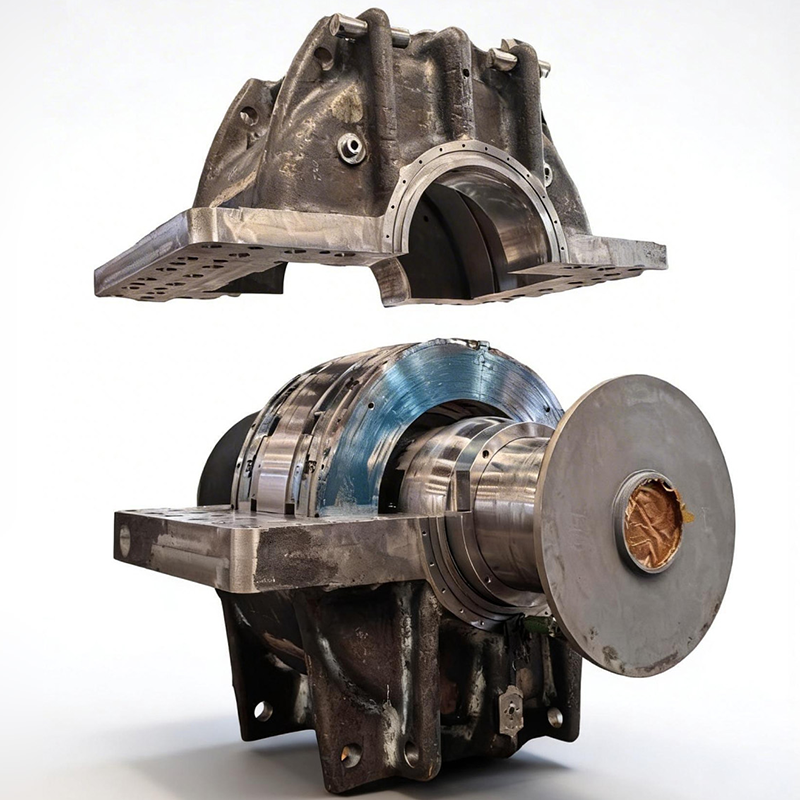
A tilting pad journal bearing is a hydrodynamic bearing made from several individual pads arranged around a rotating shaft. Each pad can pivot through a small angle, allowing its oil film geometry to adjust as the shaft rotates and operating conditions change. Hydrodynamic pressure develops between the journal surface and each loaded pad, supporting the rotor without normal metal-to-metal contact once a stable fluid film has formed.
The ability of each pad to tilt independently is central to most tilting pad bearing advantages. A conventional fixed-geometry journal bearing develops pressure within a continuous bearing surface, while a tilting pad design divides that surface into separate hydrodynamic zones. This reduces the tendency for pressure developed in one region to create destabilizing forces in another direction. Pad number, pivot position, preload, clearance, bearing length, lubricant viscosity, and load orientation all influence the final performance.
Tilting pad journal bearings are often found in machinery where shaft speed and rotor dynamics place greater demands on the bearing system. Typical applications include centrifugal compressors, steam turbines, gas turbines, high-speed pumps, generators, turboexpanders, and some high-speed gearbox arrangements. Their main value is not simply higher load support, but improved control of shaft motion under demanding dynamic conditions.
Plain journal bearings can perform reliably over a wide operating range, but their fixed geometry may create destabilizing cross-coupled forces as rotational speed increases. Under certain combinations of speed, load, clearance, lubricant properties, and rotor characteristics, the oil film can generate forces that act approximately perpendicular to shaft displacement. These forces may feed energy into rotor motion rather than damp it.
One possible result is oil whirl, a subsynchronous shaft motion associated with instability in the fluid film. If operating conditions allow that motion to interact with a rotor natural frequency, a more severe condition known as oil whip can develop. Neither phenomenon occurs in every plain bearing installation, so speed alone should not be used as the only selection criterion. Rotordynamic analysis is normally required when instability risk is significant.
One of the most important tilting pad bearing advantages is the reduction of these destabilizing cross-coupled forces. Because the pads pivot individually, their pressure fields tend to align more closely with local shaft loading. This geometry can greatly improve rotor stability, although performance still depends on the complete bearing and rotor system rather than the bearing type alone.
Improved stability is usually the primary reason engineers specify a tilting pad journal bearing for high-speed turbomachinery. The independent pads help reduce cross-coupled stiffness that can contribute to subsynchronous vibration in fixed-geometry bearings. As a result, the bearing can provide more favorable dynamic coefficients for machines operating close to stability limits.
This does not mean a tilting pad design makes a rotor unconditionally stable. Excessive clearance, unsuitable preload, incorrect pad configuration, poor lubrication, rotor imbalance, misalignment, or structural resonance can still produce vibration problems. The practical benefit is that the bearing geometry provides engineers with greater control over stiffness and damping characteristics.
For compressors, turbines, and other critical rotating equipment, this stability margin can be more important than simple static load capacity. Among the major tilting pad bearing advantages, predictable dynamic behavior is often the factor that justifies the additional design complexity and cost.
Shaft alignment can change as a machine heats up, foundations move, piping loads develop, or casings distort. A fixed bearing surface has limited ability to adapt locally to such changes. Uneven loading may then concentrate pressure and temperature in part of the bearing.
Tilting pads can adjust their angular position individually, allowing the oil film to respond more effectively to moderate changes in shaft attitude. This capability can improve load distribution and reduce localized distress when compared with a rigid fixed-geometry surface. However, tilting pads should not be treated as a substitute for correct machine alignment.
Thermal distortion also deserves attention because bearing housings, shafts, and support structures do not remain dimensionally constant during operation. One of the less visible tilting pad bearing advantages is the ability to accommodate some of these operating changes while maintaining separate hydrodynamic films at the loaded pads.
Tilting pad bearings provide several design variables that can be adjusted to suit the rotor system. Engineers can modify pad number, preload, pivot offset, clearance, bearing length, and load orientation to influence dynamic stiffness, damping, temperature, power loss, and minimum film thickness. This makes the bearing a configurable rotordynamic component rather than simply a support surface.
Load-on-pad and load-between-pad arrangements are also used to alter how the bearing responds to directional loads. Neither configuration is universally superior; the appropriate choice depends on the machine and the required dynamic characteristics. The same principle applies to pivot offset and preload, which should be selected through engineering analysis rather than treated as fixed rules.
This tunability is particularly useful when designing around critical speeds, stability margins, or known excitation frequencies. For this reason, tilting pad bearing advantages are closely linked to system-level rotor design rather than to one isolated bearing property.
Many industrial machines do not operate continuously at one speed, load, or temperature. Start-up, shutdown, process changes, seasonal conditions, and changes in lubricant temperature can all alter the operating point. A segmented tilting pad bearing can respond to some of these variations through changes in pad angle and oil-film geometry.
The benefit is especially relevant in equipment that experiences a broad operating envelope. A bearing optimized only for one nominal condition may behave differently at low load, high temperature, or reduced oil viscosity. Engineers should therefore evaluate the complete operating range rather than relying on a single rated point.
The comparison below summarizes the practical differences that usually influence engineering selection.
| Factor | Plain Journal Bearing | Tilting Pad Journal Bearing |
|---|---|---|
| Rotordynamic stability | Suitable for many moderate-duty conditions but may develop higher cross-coupled forces | Generally provides better high-speed stability |
| Oil whirl resistance | More dependent on geometry and operating condition | Usually better because pads reduce destabilizing coupling |
| Misalignment accommodation | More limited | Individual pads can adapt to moderate shaft attitude changes |
| Stiffness and damping control | Fewer design variables | Highly configurable through pad geometry and preload |
| Load capacity | Can be very effective under steady loading | Can also provide high load capacity when properly designed |
| Thermal behavior | Often simpler to predict and lubricate | Requires careful attention to pad temperature and hot-oil carryover |
| Lubrication system | Usually simpler | May require more detailed oil distribution control |
| Manufacturing complexity | Lower | Higher because pads, pivots, clearances, and geometry must be controlled |
| Cost | Usually lower | Usually higher |
| Typical use | Moderate-speed, steady-load machinery | High-speed and rotordynamically demanding machinery |
The table also highlights why tilting pad bearing advantages should not be interpreted as universal superiority. A plain journal bearing may remain the most rational solution for stable, moderate-speed equipment with predictable loading. Adding a more complex bearing where no dynamic problem exists may increase cost and maintenance requirements without delivering a meaningful operating benefit.
Bearing type alone does not determine performance. Several design and operating variables must work together, and changes to one parameter can influence temperature, stiffness, damping, oil consumption, and film thickness simultaneously.
| Parameter | Why It Matters |
|---|---|
| Shaft speed | Influences hydrodynamic pressure, shear heating, and stability behavior |
| Radial load | Affects pressure distribution and minimum film thickness |
| Bearing clearance | Influences oil-film stiffness, temperature, and rotor position |
| Preload | Changes pad geometry and dynamic coefficients |
| Pivot offset | Alters pressure development and thermal behavior |
| Pad number | Influences load distribution and dynamic response |
| LOP or LBP orientation | Changes stiffness and load sharing relative to the applied load |
| Lubricant viscosity | Affects film formation, friction, and temperature |
| Oil inlet temperature | Changes viscosity and thermal margin |
| Bearing length and diameter | Affect load capacity, heat generation, and dynamic behavior |
There is no universally optimal pad number, pivot offset, preload, or clearance. A configuration that performs well in one compressor may be unsuitable for another machine operating at a different speed, load, shaft diameter, or oil condition. Proper selection therefore requires a combination of hydrodynamic bearing analysis, thermal evaluation, and rotordynamic calculation.
The strongest case for using a tilting pad journal bearing exists when the machine has high shaft speed, limited rotordynamic stability margin, significant subsynchronous vibration risk, or operating conditions that vary enough to make fixed-geometry performance difficult to control. High-speed centrifugal compressors and turbines are common examples because their rotors may operate close to natural frequencies and require predictable dynamic coefficients.
A plain bearing can still be preferable where speed is moderate, loading is steady, vibration behavior is already satisfactory, and lifecycle simplicity matters more than maximum dynamic flexibility. Engineers should avoid upgrading solely because a tilting pad design is considered more advanced. The bearing must solve a defined mechanical or rotordynamic requirement.
A practical evaluation should consider the rotor system first. Required shaft speed, applied load, critical speeds, stability margin, lubricant supply, available housing space, thermal limits, maintenance capability, and expected operating range should all be reviewed before the final bearing geometry is selected.
The same design flexibility that creates tilting pad bearing advantages also introduces additional engineering sensitivity. Incorrect assembled clearance can alter film thickness, temperature, and dynamic coefficients. Too much or too little preload may change pad behavior in ways that are not obvious from static inspection alone.
Thermal management is another important issue. Oil leaving one pad can carry heat into the next region, while high shear rates at elevated shaft speed may increase bearing temperature and power loss. Oil supply quantity, inlet temperature, groove or nozzle arrangement, drainage, and housing geometry therefore need to be considered as part of the bearing system.
Unloaded pads may also experience undesirable motion under some operating conditions. Pad flutter, pivot wear, uneven contact, poor babbitt condition, or inadequate lubrication can reduce reliability even though the basic bearing concept is sound. These risks are manageable, but they reinforce the need for accurate manufacturing, correct assembly, and operating-condition-specific analysis.
Several recurring mistakes can undermine the expected tilting pad bearing advantages even when the bearing itself is manufactured correctly:
Selecting the bearing only from shaft diameter and speed without performing rotordynamic analysis.
Treating pad number, preload, or pivot offset as universal design rules rather than machine-specific variables.
Ignoring thermal growth, oil inlet temperature, lubricant viscosity, or hot-oil carryover.
Using incorrect assembled clearance or failing to verify housing and shaft fits.
Assuming a tilting pad bearing will automatically correct misalignment, imbalance, resonance, or structural vibration.
Retrofitting a plain bearing without checking oil supply, drain capacity, sensor locations, housing geometry, and rotor stability.
Focusing only on normal operating speed while ignoring start-up, coast-down, low-load, or transient conditions.
Avoiding these errors is often more important than choosing between two bearing types based on a general advantages list.
Early operating symptoms should be evaluated in relation to the entire rotor-bearing system. Rising pad metal temperature may indicate inadequate oil supply, excessive load, unsuitable clearance, thermal distortion, or poor heat removal. Changes in vibration amplitude or spectrum can point toward rotor imbalance, alignment problems, instability, pad behavior, or unrelated machine faults.
Uneven pad wear, babbitt wiping, pivot distress, abnormal oil discoloration, and unusual drain temperatures can provide additional clues. No single symptom identifies the cause by itself, so inspection findings should be combined with operating data such as speed, load, vibration spectrum, oil inlet temperature, and bearing metal temperature.
Where subsynchronous vibration appears, engineers should avoid assuming that the bearing is the only source. Rotor natural frequencies, seals, aerodynamic cross-coupling, foundation flexibility, couplings, and other machine elements may also contribute. Effective troubleshooting combines bearing inspection with broader rotordynamic analysis.
For replacement or custom bearings, dimensional accuracy and manufacturing control are as important as the nominal design. Buyers should confirm the required shaft diameter, housing dimensions, assembled clearance, pad geometry, pivot configuration, load orientation, lubricant specification, temperature monitoring arrangement, and expected operating conditions before production.
Inspection documentation may include dimensional reports, material certificates, babbitt bonding or surface-quality records where applicable, and verification of pad and pivot geometry. Requirements should be agreed before manufacturing rather than added after the bearing is complete. For critical machinery, the bearing supplier should also understand the intended rotor speed, load direction, oil conditions, and service environment instead of manufacturing solely from a basic dimensional drawing.
The most valuable tilting pad bearing advantages appear in applications where rotor stability, dynamic control, and adaptability to demanding operating conditions matter more than simplicity alone. By reducing destabilizing cross-coupled forces and allowing stiffness, damping, preload, clearance, and pad geometry to be engineered for a specific rotor system, tilting pad bearings can provide a significant advantage in high-speed machinery. Plain journal bearings remain appropriate for many stable, moderate-duty applications, so selection should be based on operating data and rotordynamic requirements rather than bearing type alone.
The principal benefits are improved rotordynamic stability, reduced destabilizing cross-coupled forces, better resistance to oil-whirl-related instability, greater ability to accommodate moderate shaft attitude changes, and more control over stiffness and damping. Their design can also be tailored through pad geometry, preload, clearance, and pivot position. These benefits are most valuable in high-speed or dynamically demanding rotating machinery.
Not in every application. Tilting pad bearings are generally preferred where high-speed stability and controlled dynamic behavior are important, while plain bearings may be more practical for moderate-speed, steady-load machinery. Cost, lubrication complexity, thermal behavior, and maintenance requirements should also be considered.
They are highly effective at reducing the destabilizing cross-coupled forces associated with oil whirl, which is one of the most important tilting pad bearing advantages. However, no bearing should be assumed to eliminate every form of rotor instability under every operating condition. The complete rotor-bearing system still requires proper analysis.
Load-on-pad places the principal load direction through one pad, while load-between-pad places the load between two adjacent pads. The two arrangements produce different stiffness, load distribution, and temperature characteristics. Selection depends on the rotor system and should be based on calculated performance rather than a general rule.
Possible causes include excessive load, unsuitable clearance, insufficient oil flow, high inlet oil temperature, hot-oil carryover, incorrect preload, surface condition problems, or thermal distortion. Shaft speed and lubricant viscosity also influence heat generation. Temperature should therefore be evaluated together with operating load, oil conditions, and bearing geometry.
Engineers typically need shaft diameter, rotational speed, radial load, load direction, lubricant type and viscosity, inlet oil temperature, housing dimensions, allowable bearing temperature, operating range, and relevant rotordynamic requirements. Additional information about critical speeds, vibration history, and existing bearing performance can improve the selection process.


