
Views: 0 Author: Site Editor Publish Time: 2026-06-27 Origin: Site
Thrust shafts absorb the massive forward and astern axial forces generated by massive ship propellers. They stand as the most critical load-bearing components inside any modern vessel's engine room. Without them, converting raw engine torque into controlled forward momentum becomes physically impossible. Premature fatigue failure or even a slight mechanical misalignment often leads to catastrophic consequences. You face extensive drydock repairs and severe operational downtime when these heavy structural components fail. Replacing compromised parts drains vital maintenance resources and halts tight shipping schedules abruptly. This comprehensive guide provides a detailed technical framework for evaluating advanced forging quality and strict dynamic balancing protocols. We will explore complex compliance standards to help you source a highly reliable replacement or new OEM component. You will learn exactly how to assess deep metallurgical integrity and exact manufacturing precision.
Material integrity dictates lifespan: Custom-forged alloy steel shafts with continuous grain flow provide superior fatigue resistance compared to standard rolled or cast alternatives.
Dynamic balancing is non-negotiable: Precise alignment and balancing reduce vibrational fatigue, a leading cause of thrust bearing failure in high-load commercial vessels.
Compliance mitigates risk: Sourcing requires strict adherence to international classification societies (e.g., ABS, DNV, Lloyd's Register) encompassing rigorous Non-Destructive Testing (NDT).
Vendor consolidation matters: Choosing a partner with integrated open-die forging, deep-hole boring, and finish-machining shortens lead times and ensures single-source accountability.
The operational stress placed on a marine thrust shaft is immense. It must transmit extreme torsional torque from the heavy diesel engine directly to the propeller. Simultaneously, it transfers pure axial thrust back to the ship's hull. The thrust block assembly absorbs this massive forward and astern pressure. This dual load profile demands exceptional resilience. A typical commercial vessel generates hundreds of tons of axial force. The component constantly fights against complex hydrodynamic resistance.
Common failure modes emerge quickly when you ignore operational limits. Torsional vibration acts as a primary destructive force. It creates microscopic fissures along the outer surface. Axial resonance compounds this mechanical stress. It leads directly to severe bending fatigue. Over time, these combined forces will crack poorly manufactured materials. Torsional shear stress maximizes near the collar transition zones. Engineers must calculate these dynamic loads perfectly.
What defines a successful component? A highly reliable ship propulsion shaft must exhibit outstanding tensile strength. It needs precise dimensional stability under heavy cyclic loading. Flawless metallurgical integrity separates robust components from frequent failure liabilities. Even minor metallurgical defects grow into massive cracks. You cannot compromise on raw material density. The entire propulsion train relies on this single structural foundation.
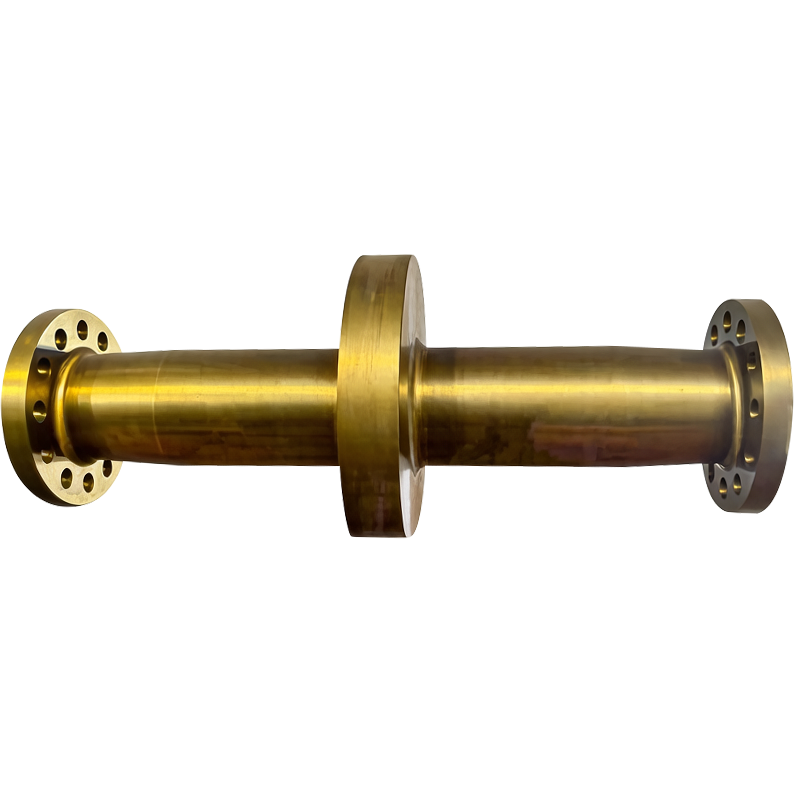
Open-die forging remains the definitive industry standard for massive marine applications. This method compresses giant metal blocks under heavy hydraulic presses. The press applies thousands of tons of downward force. It eliminates internal voids entirely. It also consolidates the dense core structure. You simply cannot achieve this density through basic casting or rolling methods. Cast components often hide internal air pockets. Rolled steel lacks the necessary directional strength for heavy marine operations.
Engineers must carefully evaluate standard carbon steels against high-strength materials. Selecting alloy steel shafts becomes mandatory for massive container ships. Specific alloys like 4340 or 34CrNiMo6 excel in high-horsepower vessels. Carbon steel might suffice for lighter inland barges. However, heavy deep-sea commercial ships require advanced alloy combinations. Nickel adds toughness, while chromium increases hardenability. Molybdenum prevents unwanted temper brittleness during cooling phases.
Custom forging provides a distinct, highly visible grain flow advantage. The hydraulic press physically aligns the internal grain structure. It shapes the grains alongside the component's final physical geometry. This continuous grain flow vastly improves overall impact resistance. It maximizes directional strength where operational stress concentrates most heavily. The transition radius near the collar benefits immensely from this unbroken grain pattern.
Heat treatment realities require strict procedural adherence. Normalization, quenching, and tempering define the final mechanical properties. Normalizing refines the coarse grain structure immediately after heavy forging. Quenching hardens the exterior rapidly. Precise tempering restores necessary core ductility. A brittle core shatters under heavy impact. Therefore, operators carefully control the tempering oven temperatures.
| Material Type | Tensile Strength | Impact Resistance | Ideal Vessel Application |
|---|---|---|---|
| Standard Carbon Steel | Moderate | Standard | Light coastal vessels, barges |
| 34CrNiMo6 Alloy Steel | Very High | Excellent | Heavy commercial freighters |
| 4340 Alloy Steel | Exceptional | Superior | High-speed naval, icebreakers |
Massive forged thrust shafts require stringent balancing protocols. Static balancing simply finds heavy resting spots. It only measures imbalances while the massive component remains stationary. Dynamic balancing represents a far superior methodology. It measures asymmetric forces while the component spins rapidly at operational speeds. For critical marine applications, dynamic balancing is absolutely non-negotiable. It simulates the exact rotational forces experienced at sea.
Vibration mitigation directly protects the entire mechanical drivetrain. Dynamic balancing at full operational RPM prevents premature wear. It stops excess kinetic load from destroying delicate stern tube bearings. It also preserves the sensitive thrust pads located inside the main thrust block. Unbalanced rotational mass creates destructive centrifugal forces. These forces will literally shake a bearing housing apart over several months.
Proper alignment engineering ensures safe, continuous operation. Industry-standard principles dictate strict load distribution limits. We strictly follow guidelines similar to the ABS Shaft Alignment rules. You must calculate the exact bearing load accurately. Misalignment shifts the heavy load improperly onto edges. This drastically reduces the primary component life. Sag and gap calculations must account for hull deflection in water.
Implementation risks remain exceptionally high during final drydock installation. Installing a perfectly forged steel piece is useless if you ignore dynamic balance. Poor machining tolerances directly amplify final vibration levels.
Common Mistake: Shipyards sometimes try to align components while the vessel rests heavily on drydock blocks. Hull shapes change significantly once floating. Always verify final alignment calculations in the water to prevent catastrophic bearing failure.
Reliable component evaluation relies entirely on verifiable testing. We anchor our assessment in rigorous scientific validation, never basic marketing claims. Rigorous testing protocols expose hidden structural flaws. They catch these errors long before final assembly occurs. You must insist on comprehensive metallurgical proof.
Non-Destructive Testing (NDT) forms the ultimate backbone of quality assurance. The required testing suite includes several highly specific diagnostic methods.
Ultrasonic Testing (UT): Technicians blast high-frequency sound waves deep into the steel. This detects hidden internal voids, microscopic inclusions, or dangerous flaking.
Magnetic Particle Inspection (MPI): Inspectors magnetize the heavy forging. They apply iron particles to reveal shallow surface micro-cracks on ferromagnetic metals.
Dye Penetrant Testing (PT): Technicians apply specialized fluorescent liquids. These liquids seep into and highlight microscopic surface defects under ultraviolet light.
Fatigue life optimization depends heavily on the final surface finish. We mitigate dangerous stress concentrations using specialized finishing techniques.
Shot peening compresses the outer layer deliberately. This compressive stress prevents crack initiation entirely.
Precision grinding of the collar transition radii smooths out sharp geometric changes. Sharp corners always invite rapid fatigue failure.
Mirror-polishing the primary thrust collars minimizes friction. This protects the Babbitt-lined primary bearing pads.
Class society certification provides final operational authority for the vessel. You must maintain strict raw material traceability straight from the original steel mill. Standard 3.2 material certificates verify exact chemical compositions independently. Third-party witness testing guarantees complete regulatory compliance. Agencies like ABS, DNV, or Lloyd's Register must sign off on the final test parameters.
Procurement teams must apply a deeply skeptical, evidence-based approach. Sourcing heavy marine propulsion system parts demands exhaustive vendor vetting. A glossy marketing brochure never compensates for a lack of genuine engineering capacity. You are buying operational security, not just heavy metal.
Always assess a supplier's true in-house manufacturing capabilities first. Does the facility handle massive open-die forging directly? Do they conduct heat treating and finish machining entirely under one roof? Fragmented supply chains drastically increase dimensional risks. Shipping unmachined parts between different subcontractors extends lead times unnecessarily. Single-source providers maintain much tighter internal quality control. They hold absolute accountability for the final geometry.
Verify the heavy manufacturer's absolute capacity limits carefully. Look closely at their maximum hydraulic forging tonnage. Check their long-bed lathe capacities and heavy overhead crane limits. Heavy marine forgings require massive physical infrastructure. Many smaller machine shops simply lack the floor space and lifting capacity.
Before issuing any formal Request for Quote (RFQ), request specific technical documentation.
Best Practice: Always request a sample Inspection and Test Plan (ITP) from a similar past project. Demand a dimensional tolerance capability report to verify true machining precision. These vital documents prove whether the vendor can actually meet your exact engineering specifications.
Sourcing massive heavy marine components fundamentally remains an exercise in strict risk management. The precise intersection of pure steel, meticulous forging, and rigorous dynamic balancing dictates success. It ultimately determines your vessel's total operational lifespan.
Prioritize continuous grain flow forging to maximize heavy fatigue resistance.
Demand dynamic balancing at operational RPMs to protect critical bearing assemblies.
Require integrated manufacturing facilities to minimize dangerous dimensional errors.
Mandate comprehensive third-party NDT documentation to ensure absolute regulatory compliance.
We invite technical buyers and marine engineers to submit their detailed engineering drawings today. Our seasoned experts will perform a comprehensive, no-obligation manufacturability review. Consult our engineering team directly to discuss custom forging timelines. We will help you secure your fleet's long-term mechanical reliability.
A: The typical lead time ranges from eight to sixteen weeks. Raw material sourcing and initial open-die forging usually consume the first month. Heat treatment, deep-hole boring, and precision finish machining require several additional weeks. Complex classification society witness testing can slightly extend this timeline depending on surveyor availability.
A: A standard propeller shaft primarily transfers rotational torque directly to the propeller hub. A thrust shaft features an integrated, heavily forged collar. This specific collar absorbs the massive axial force generated by the propeller and transfers it into the ship's hull via the thrust block.
A: Yes, we provide full classification society certifications. Our manufacturing process integrates third-party surveyors from ABS, DNV, Lloyd's Register, and RINA. We supply complete 3.2 material certificates ensuring full traceability from the raw steel ingot to the final machined component.
A: Our integrated facilities accommodate massive heavy-duty marine components. We can successfully forge and dynamically balance shafts exceeding 15 meters in length. Our overhead crane limits and heavy lathe capacities handle individual component weights up to 40 tons, ensuring we meet the demands of large commercial vessels.


