
Views: 0 Author: Site Editor Publish Time: 2026-09-07 Origin: Site
Precise shaft alignment dictates the survival of any commercial vessel. The marine bearing housing anchors this critical alignment. It guarantees the continuous operation of vital marine propulsion system parts. Substandard housing design leads directly to unplanned drydocking. Similarly, neglected inspection protocols invite catastrophic equipment failure. These mechanical breakdowns halt shipping operations and trigger massive revenue loss. Engineering and procurement teams face immense pressure. They must evaluate design specifications accurately. They need to verify material integrity and long-term viability without bias. This guide serves as your objective evaluation framework. You will learn how to assess structural rigidity effectively. You will discover predictive inspection methods. Ultimately, you will understand how proper component integration prevents devastating downstream failures across your fleet.
Proper material selection and structural rigidity in bearing housings are non-negotiable for mitigating dynamic hull deflections.
Proactive inspection utilizing NDT (Non-Destructive Testing) and vibration analysis prevents escalating damage across the shaft line.
Evaluating a Marine Bearing Seat requires looking beyond dimensional tolerances to include thermal dissipation capacity and Class Society compliance.
Component integration is high-risk; misalignment at the bearing housing is a primary catalyst for downstream marine shaft coupling failure.
A marine bearing housing is not merely a passive structural envelope. It actively absorbs immense radial and axial loads. Vessels operate in harsh, high-vibration maritime environments. Heavy seas generate dynamic forces. The housing must transfer these forces safely to the ship's foundation. It supports the rotating shaft while maintaining exact clearances. When the housing fails to absorb these stresses, the entire propulsion system suffers.
Engineering teams measure housing success through strict operational metrics. A successful marine bearing housing deployment achieves specific benchmarks. First, it results in zero alignment drift under the maximum continuous rating (MCR) of the engine. Second, it delivers optimal thermal management. The housing must dissipate heat fast enough to protect the internal lubricating oil film. Finally, it must guarantee a 20+ year lifecycle compliance. The structural casing should outlast multiple generations of internal bearing shells.
Housing deformation triggers cascading financial and operational impacts. Even microscopic warping destroys the internal bearing clearances.
Excessive Bearing Wear: Misalignment forces the shaft to rub against the babbitt material. This destroys the bearing shell prematurely.
Vibration Escalation: Structural weakness amplifies normal operating vibrations. These vibrations travel through the hull and damage auxiliary machinery.
Total Propulsion Loss: A cracked or failed housing causes immediate shaft seizure. You lose steering and propulsion entirely.
Emergency Drydocking: Repairing a structural housing failure requires pulling the vessel from service. Off-hire penalties and emergency shipyard fees compound the financial damage.
Procurement teams must evaluate designs based on metallurgical properties and thermodynamic performance. Selecting the wrong material or geometry compromises the entire installation.
Manufacturers typically use three primary materials for bearing housings. Each offers distinct tensile strength trade-offs.
Comparison Chart: Material Selection for Bearing Housings
| Material Type | Tensile Strength | Cost Efficiency | Best Application Scenario |
|---|---|---|---|
| Cast Iron (Nodular) | Moderate | High | Standard cargo vessels with predictable load profiles. |
| Cast Steel | High | Medium | Heavy-duty applications requiring high impact resistance. |
| Fabricated Steel | Very High | Low (Custom built) | Specialized naval or ice-class vessels facing extreme dynamic forces. |
Corrosion resistance is equally vital. The marine environment constantly attacks exposed metals. Quality housings require advanced protective coatings. Epoxy-based marine paints and localized galvanic protection prevent saltwater degradation. Without proper coating systems, surface pitting weakens the housing's structural integrity.
Modern vessels often utilize high-load hydrodynamic tilting pad journal bearings. These bearings rely on an unbroken wedge of oil. The housing design directly dictates fluid dynamics.
Lubrication flow paths must be meticulously engineered. Internal channels guide pressurized oil directly into the load zone. A well-designed reservoir prevents oil starvation. Oil starvation causes boundary friction. Boundary friction generates intense heat and melts the bearing lining instantly. Therefore, the housing must feature aggressive heat dissipation geometry. External cooling fins or integrated water-cooling jackets pull heat away from the load center. You must verify these thermal dissipation capacities during the design phase.
Maintenance engineers prefer specific design geometries. You must evaluate the ease of access for bearing shell replacement. Split-casing designs allow crews to remove the upper half of the housing. This grants direct access to the internal components. You can replace the bearing shell without removing the massive drive shaft. Solid housings offer slightly higher rigidity. However, they complicate maintenance immensely. Solid designs require complete shaft decoupling for basic internal repairs. Always weigh rigidity requirements against future maintenance labor.
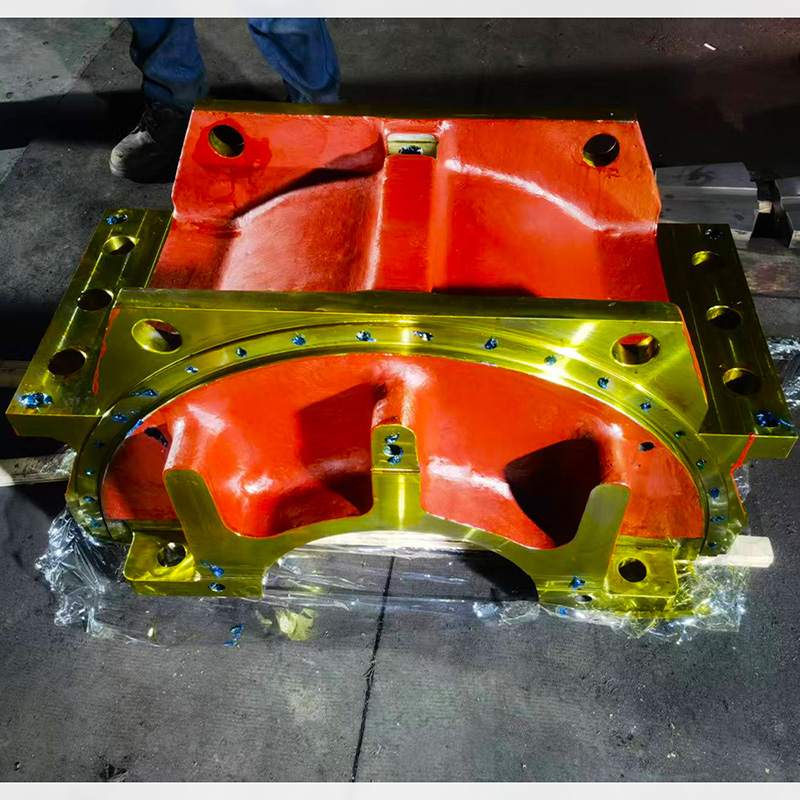
A bearing housing does not operate in isolation. It forms one node in a complex dynamic system. Poor integration inevitably destroys downstream components.
Hulls are not rigid structures. They bend and flex dynamically in rough seas. Cargo loading also changes the hull's shape. The housing must accommodate or resist these shaft bending moments. Engineering teams calculate specific deflection tolerances. The housing pedestal must possess enough stiffness to hold the shaft true. If the housing flexes sympathetically with the hull, alignment is lost. Rigid foundation mounting is critical.
Evaluate compatibility carefully during mounting procedures. The housing must align perfectly when mounted along a forged intermediate shaft. The intermediate shaft connects the main engine to the propeller tail shaft. It carries immense rotational torque. The bearing housing supports this long span. Miscalculating the load distribution here causes the intermediate shaft to whip. Shaft whipping destroys bearing seals and accelerates metal fatigue.
System integration failures rarely remain isolated. Tracing the root cause of marine shaft coupling failure often leads back to the support structures. A coupling fractures when subjected to severe bending stresses. These bending stresses occur when the support foundation shifts. Inadequate Marine Bearing Seat rigidity is a primary culprit. If the bearing seat deforms under load, the shaft drops. This drop levers the flange couplings apart. Establishing a flawless baseline alignment prevents this disaster. Laser alignment tools must verify the seat's position before final bolt torquing.
Common Mistakes in System Integration: Many shipyards utilize static alignment calculations. They ignore dynamic thermal expansion. When the engine reaches operating temperature, the components expand. This expansion alters the bearing housing alignment. Always calculate alignment using hot-condition parameters.
Neglecting a bearing housing guarantees future failures. Proactive inspection strategies identify microscopic flaws before they cause operational halts.
The maritime industry is shifting away from reactive repairs. You must adopt evidence-based predictive maintenance. Predictive maintenance relies on constant data gathering. It replaces parts based on actual condition rather than arbitrary schedules. This approach maximizes vessel uptime.
Visual inspections cannot detect internal fatigue. Surveyors rely on rigorous Non-Destructive Testing (NDT) to evaluate housing health. You should mandate these specific methods during drydocking:
Ultrasonic Testing (UT): Technicians use high-frequency sound waves. These waves penetrate the thick metal casing. UT detects subsurface cracking deep inside the housing body. It identifies casting voids that compromise structural integrity.
Magnetic Particle Inspection (MPI): This method focuses on the surface. Technicians magnetize the housing and apply ferrous particles. The particles cluster around invisible surface cracks. MPI is highly effective for detecting surface fatigue at high-stress mounting points.
Dye Penetrant Testing (PT): Used primarily on non-magnetic materials or for quick surface checks. Capillary action draws the dye into micro-fractures.
Do not wait for drydocking to assess housing health. Establish continuous operational monitoring protocols. Set rigid baselines for temperature telemetry. A sudden spike in housing temperature indicates impending lubrication failure. Deploy continuous vibration analysis. Sensors mounted directly on the housing detect early-stage structural degradation. A shift in vibration frequencies warns crews about loose foundation bolts or degrading internal clearances.
Maritime operations require strict adherence to international safety regulations. You must ensure all design and inspection reports meet rigorous IACS standards. The International Association of Classification Societies enforces structural safety. Major societies include DNV, ABS (American Bureau of Shipping), and Lloyd’s Register. Compliance proves the housing can withstand defined sea states. Insurance providers mandate Class Society certification for all critical propulsion components.
Best Practices for Compliance: Always invite a Class Society surveyor to witness the final housing alignment. Documenting this step prevents future liability disputes if a shaft failure occurs mid-ocean.
Procuring a massive structural component requires stringent vendor vetting. A cheap housing often masks poor metallurgical control.
Assess vendor facilities comprehensively. Look for heavy machining precision. The manufacturer must possess multi-axis CNC boring machines capable of handling massive dimensions. Verify their in-house casting quality control. Do they test their own pours? Foundries outsourcing their quality checks often ship porous castings. Demand proof of their casting stress-relief processes. Residual casting stress causes the housing to warp months after installation.
Never accept a bearing housing without full material traceability. Demand comprehensive documentation before taking delivery. You must request EN 10204 3.1 or 3.2 material certificates. A 3.2 certificate is ideal because an independent third-party inspector validates it. Furthermore, insist on reviewing Factory Acceptance Test (FAT) data. The FAT proves the housing met all dimensional tolerances before it left the factory floor.
Top-tier suppliers do more than pour metal. They provide vital engineering support. Evaluate the supplier’s ability to conduct advanced operational modeling. Can they execute torsional vibration calculations (TVC)? TVC ensures the housing will not resonate dangerously with engine frequencies. Can they provide finite element analysis (FEA)? FEA models how the specific housing reacts to the unique bending forces of your vessel's hull design. Vendors lacking these engineering capabilities pose a significant risk to your fleet.
A marine bearing housing acts as a foundational investment in fleet safety and operational uptime. It anchors the propulsion system and resists immense dynamic forces. Engineering teams must execute rigorous upfront evaluations to prevent catastrophic mechanical failures.
Audit current specifications: Review your existing shaft line designs to ensure the housing materials match the operational loads.
Prioritize maintainability: Opt for split-casing geometries to reduce future drydocking labor costs.
Demand verifiable data: Always request comprehensive FEA modeling and EN 10204 3.2 material certificates when shortlisting manufacturers.
Implement predictive monitoring: Install permanent vibration and temperature sensors to catch degradation before it escalates.
A: Standard visual and NDT inspections align with the typical 5-year drydocking schedule mandated by Class Societies. However, modern reliability standards require continuous predictive monitoring. You should track vibration and temperature telemetry daily while the vessel is underway to detect anomalies between drydock periods.
A: The bearing seat refers to the heavy structural casing that mounts to the ship's foundation. It absorbs structural loads. The bearing shell is the softer internal wear component (often lined with babbitt metal) that directly contacts and lubricates the rotating shaft.
A: A stiffer housing can dampen certain structural vibrations. However, it rarely solves the root problem. You must diagnose and fix underlying issues, such as a bent forged intermediate shaft, hull deformation, or hydrodynamic propeller imbalance, to eliminate destructive vibrations entirely.
A: You should require certification from primary IACS members like DNV, ABS, or Lloyd’s Register. Material traceability certificates (like EN 10204 3.2) are mandatory. They prove the metal's metallurgical integrity, which is required for regulatory compliance and maritime insurance validation.


