| Availability: | |
|---|---|
| Quantity: | |
The 38CrNi3MoV Dynamic Balance Block for Tilting Pad Bearings is a core precision component engineered to optimize load distribution and structural balance for heavy-duty tilting pad thrust bearing systems. Also known as a high-performance balancing weight for thrust bearings, this component is installed alongside thrust pads on the bearing support ring base, serving as a critical solution to compensate for uneven force and local mass deviation during axial load transmission. Designed for long-term stable operation under extreme working conditions, it is an indispensable part to ensure the reliability of high-speed rotating equipment thrust systems.
The 38CrNi3MoV balance block for tilting pad thrust bearings corrects the stress state of thrust pad assemblies, eliminating local load concentration during axial thrust transmission. This ensures uniform force across all thrust pads, significantly improving the fitting state and stability of the lubricating oil film between the pad and thrust shaft.
By fine-tuning the internal balance of the bearing system, this dynamic balance block for thrust bearings effectively suppresses operational vibration and reduces uneven wear of bearing components, extending the service life of the entire thrust bearing assembly and minimizing unplanned downtime for industrial equipment.
The component maintains exceptional structural stability under continuous heavy load, high-speed, and variable working conditions, meeting the strict requirements of critical industrial rotating equipment.
Parameter | Standard Value |
Core Material | 38CrNi3MoV Alloy Steel |
Hardness Range | 280-320 HB |
Dimensional Tolerance | ±0.005 mm |
Critical Surface Flatness | ≤0.002 mm/100×100 mm |
Surface Roughness | Ra ≤0.8 μm |
Applicable Temperature Range | -40℃ to 350℃ |
Customization Scope | Full customization per customer drawings & technical requirements |
This high-precision dynamic balance block is widely adapted for thrust bearing devices in critical industrial fields, including marine propulsion systems, industrial steam turbines, hydro turbines, power generation equipment, and large-scale rotating machinery. It is specially optimized for harsh operating environments such as high humidity, high temperature, and long-term continuous operation, delivering reliable performance for heavy equipment manufacturers and industrial operators.

We select premium 38CrNi3MoV high-strength alloy steel for this balance block, which delivers outstanding tensile strength, impact toughness, and fatigue resistance, far exceeding standard carbon steel materials for long-term heavy load operation. The manufacturing process adopts 5-axis CNC milling technology for precision machining of all force-bearing and assembly reference surfaces, ensuring strict compliance with dimensional accuracy and flatness requirements. After machining, the component undergoes ultrasonic cleaning and uniform anti-rust oil coating to prevent oxidation and corrosion during transportation and storage.

We provide fully customized machining services for the 38CrNi3MoV balance block based on customer-provided thrust bearing structure drawings, thrust pad layout, and technical parameters, ensuring a perfect fit with mating thrust pads and support ring bases. Beyond single component manufacturing, we offer full system supporting solutions, including matched thrust pads, thrust pad base rings, thrust shafts, white metal bearing bushes, bearing housings, and oil supply semi-rings, all manufactured under unified machining standards for optimal compatibility.
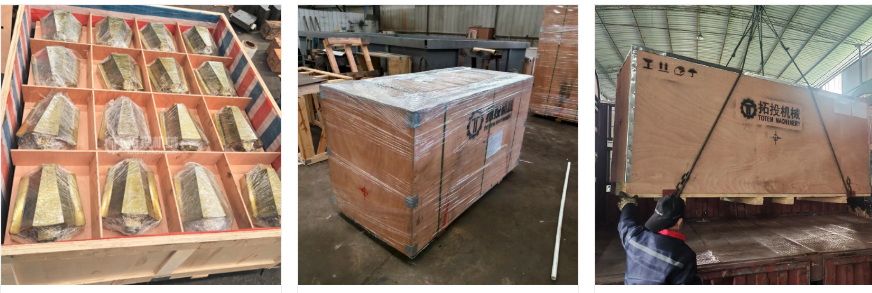
We adopt a 3-layer export-grade packaging solution to protect components during global transportation:
1) Inner layer: Critical surfaces are coated with anti-rust oil and wrapped with VCI anti-corrosion paper to isolate moisture;
2) Buffer layer: Pearl cotton and custom positioning blocks are used for shock absorption and fixation;
3) Outer layer: Reinforced export wooden case, suitable for sea, land, and air transportation, with customizable handling marks as required.
As a professional manufacturer of precision bearing components for industrial clients, TOTEM MACHINERY combines advanced CNC machining capabilities, strict full-process quality control, and systematic design expertise. We not only provide single component machining per drawings, but also deliver full bearing and lubrication system solutions, helping your equipment achieve safe, stable, and long-term operation, with responsive technical support and flexible customization services to meet your project-specific requirements.
Diagnose reciprocating compressor crosshead wear to prevent costly downtime. Master clearance inspections and repair vs. replacement strategies.
Selecting reciprocating compressor cylinder material is vital for safety and life-cycle cost. This article compares three cast families: iron (grey/ductile), steel (carbon/low-alloy), and stainless (austenitic CF8M/CF3M, martensitic 17-4PH). It examines strength, hardness, thermal conductivity, expansion, self-lubrication, corrosion resistance, weldability, and failure modes (wear, corrosion, cracking, creep).
This article analyzes small crankshaft manufacturing for reciprocating compressors. These core components endure alternating loads over 200 MPa, speeds to 3000 r/min, thin oil film, and -20 to 80°C temperatures. Material choice prioritizes 40CrNi2MoA for fatigue strength, with 42CrMo as economic alternative. Process includes die forging (ratio >=3), quenching/tempering to 28-34 HRC core, surface hardening to 54-58 HRC, and precision machining to IT7, Ra <=0.4 μm. Quality control covers dimensions, hardness, MPI, UT, with three-level inspection. Failure prevention targets fatigue, wear, cracking, and imbalance. A case study achieved 99.5% yield. Cost breakdown shows machining as largest share; batch optimization and near-net-shape forging reduce costs. Trends include laser hardening, 3D repair, in-process sensing, composites, and green quenchants. Zero-defect production integrates materials, heat treatment, precision machining, and quality management for reliable compressor operation.
Professional guide to the casting and assembly of reciprocating compressor cylinder blocks. Covers key casting difficulties, systematic process solutions, core assembly challenges, and rigorous testing procedures to ensure stable and reliable cylinder performance under industrial operating conditions.
The piston rod in a reciprocating compressor connects the crosshead to the piston head, transmitting axial force through every compression cycle. When it fails, the compressor stops.
The compressor cylinder is the pressure-bearing heart of a reciprocating compressor. It contains the compression chamber, guides the piston, and seals against high-pressure gas through every cycle. As the piston rings slide against the cylinder bore, wear is inevitable.
The crosshead sits between the connecting rod and the piston rod in a reciprocating compressor.
Learn to select thrust bearings to prevent axial displacement, downtime, and drivetrain damage. Compare load, speed, and lubrication limits.
Match thrust vs journal bearings to radial and axial loads to prevent rotor crashes and downtime. Expert selection guide for engineers.
Prevent propeller shaft bearing failures. Learn oil vs water lubrication, sizing, and alignment to boost vessel reliability and cut downtime.
Compare fixed vs controllable pitch propellers for marine propulsion. Match your vessel's operational profile, maneuverability, and maintenance needs.
Learn how to evaluate marine bearing housings—from materials to NDT inspection—to prevent shaft misalignment and costly propulsion failures.
Repair or replace your marine propeller shaft? Get expert guidance on diagnostics, NDT testing, and alignment to avoid costly failures.
Avoid marine propeller shaft failure. Learn torque-based sizing, Aquamet 22 materials, and precise machining specs for long-term reliability.
Confused by marine propeller shaft vs tail shaft? Learn key differences, material specs, and inspection tips to avoid costly failures at sea.
Prevent costly marine fleet downtime. Master stern tube bearing selection, manage clearance tolerances, and mitigate shaft wear.
Prevent costly dry-docking and environmental fines. Learn to select and maintain marine stern tube bearings, seals, and lubrication systems.
This paper presents a technical analysis of welding for car dumper steel structures, which endure alternating loads and fatigue over millions of cycles. The structural section describes the main load-bearing components. The welding process section addresses procedure qualification requirements, thermal cycle management, and post-weld heat treatment, as well as deformation control through symmetric welding sequences and counter-deformation tooling. The parameter matrices offer reference values for butt and T-joints across varying thicknesses, and a carbon equivalent based preheating quick reference table. Quality inspection encompasses 100% visual inspection, Non-Destructive Testing, mechanical property tests on product test plates, dimensional checks for camber and flatness, and coating inspection for corrosion protection. The paper systematically consolidates the technical framework for car dumper steel structure welding, serving as a reference for industry practitioners.
Compressor valves control the intake and discharge of gas in every compression cycle. They open and close hundreds or thousands of times per minute, driven by pressure differentials rather than external actuation.
Large industrial components create machining problems that rarely appear at smaller scales.