


Precision Machined Dynamic Balancing Weight for Thrust Pad Bearings - Optimized Load Distribution & Vibration Reduction
This high-precision dynamic balancing weight ensures stable thrust bearing operation by evenly distributing axial loads and minimizing vibration in heavy rotating equipment. Engineered for marine propulsion, turbines, and industrial thrust bearings, it enhances system longevity and reduces wear.
- Compensates for uneven mass/load distribution in thrust bearing assemblies
- Minimizes abnormal vibration and premature wear in rotating equipment
- Compatible with Michell, tilt pad, and white metal thrust bearing systems
- Critical component for marine, steam turbine, and hydroturbine applications
| Quantity: | |
|---|---|
The precision-machined dynamic balancing weight serves as a critical core component within thrust pad bearing systems. Engineered specifically for heavy rotating equipment, this component is designed to optimize internal load distribution and maintain structural balance during continuous operation. By effectively compensating for uneven mass distribution and irregular axial loads, it mitigates local load concentration that often leads to premature component failure. Widely utilized in marine propulsion systems, steam and hydro turbines, and industrial tilt pad or Michell thrust bearing assemblies, this balancing weight helps equipment manufacturers and industrial facility operators reduce abnormal wear, control operational vibration, and significantly improve the long-term reliability of their rotating machinery.

When integrated alongside thrust pads on the thrust pad base ring, the balancing weight actively compensates for uneven local mass and axial load variations during thrust transmission. This fine-tuning of the internal force state prevents local load concentration on thrust plate components. Consequently, it stabilizes the critical oil film formation between thrust shoes and mating surfaces, directly reducing the risk of premature wear, abnormal vibration, and unplanned equipment downtime for industrial operations.
Fully compatible with Michell, tilt pad, and white metal thrust bearing systems, this dynamic balancing weight is engineered to maintain consistent force equilibrium even under continuous high-load and high-speed operating conditions. By ensuring the reliable, long-term running of high-value rotating equipment, it helps OEM manufacturers and industrial operators lower overall maintenance frequencies, minimize repair interventions, and reduce part replacement costs across the equipment's lifecycle.
Industrial rotating equipment often operates in demanding environments. These balancing weights are designed to withstand long-term service in high-temperature, damp, and heavy-load working conditions. Supported by optional anti-rust and anti-corrosion surface treatments tailored to specific project needs, the design maintains functional stability over extended periods. This environmental resilience extends the service life of the bearing assembly and reduces the necessity for frequent component replacements.
This component is essential for main and auxiliary engine thrust bearing systems utilized in commercial vessels, naval ships, and offshore engineering equipment. It ensures stable thrust transmission and reliable mechanical operation during long-distance voyages, specifically designed to withstand the variable and unpredictable load conditions typical of marine environments.
Widely implemented in thermal power and hydroelectric power generation plants, the dynamic balancing weight optimizes the load balance of turbine thrust bearings. It actively compensates for uneven loads experienced during heavy-load, continuous power generation cycles, thereby protecting critical turbine units and extending their operational service life.
The balancing weight is fully compatible with heavy-duty pumps, large-scale compressors, industrial fans, and other rotating machinery fitted with tilt pad thrust bearings. By improving operational stability and minimizing vibration, it helps industrial facilities reduce routine maintenance frequency and lower the total cost of ownership for critical infrastructure.
Engineered to work in precise coordination with white metal bearing components, the balancing weight matches seamlessly with thrust shafts, thrust pads, and supporting structures. This synergy is vital for maintaining the stable operating performance required by specialized, heavy-duty bearing assemblies.
We provide comprehensive custom machining services to manufacture balancing weights strictly according to your specific thrust bearing structural drawings, shoe arrangement layouts, and technical requirements. Whether your project requires single-part prototype machining for testing or large-volume batch production for OEM assembly, our processes ensure every part achieves an exact fit with your existing thrust bearing shoes and base rings.
Beyond the machining of individual balancing weights, we offer complete, matched component solutions for your entire thrust bearing system. Our supply capabilities include thrust pads, thrust discs, propulsion shafts, white metal bearing bushes, bearing housings, and oil supply semi-rings. By utilizing unified processing standards and strict quality control across all components, we simplify your supply chain and ensure reliable operation, seamless assembly, and perfect coordination of the complete thrust bearing system.
The operational reliability and structural integrity of dynamic balancing weights for thrust pad bearings depend primarily on the quality of raw materials and the precision of the manufacturing process. We implement strict material selection criteria and advanced CNC machining workflows to ensure every component provides optimal load distribution and long-term mechanical stability under demanding conditions.
Standard Material (High-Grade Carbon Steel): Typically utilizing C45 carbon steel, this standard option is selected for its excellent structural strength, dimensional stability, and overall cost-effectiveness. It is highly suitable for most general industrial machinery, standard pumps, and power generation applications where reliable load-bearing capacity is essential.
Upgraded Material (Alloy Steel): Engineered for extreme working environments, materials such as 42CrMo alloy steel provide enhanced fatigue resistance, high-temperature tolerance, and superior anti-deformation performance. This upgraded material is the preferred choice for heavy-duty marine propulsion systems, large-scale hydro turbines, and equipment subjected to intense, continuous operational stress.
Custom Material Sourcing: We fully support material customization based on specific project requirements and technical specifications. Depending on your operational environment, we can machine balancing weights from stainless steel, duplex steel, or specialized marine-grade alloys to meet exact engineering demands.
Precision CNC Milling: The primary force-bearing surfaces and assembly reference points of the balance block are processed using high-precision multi-axis CNC milling centers. This guarantees that dimensional accuracy and surface flatness fully comply with the stringent assembly requirements of tilting pad thrust bearings. Precise milling effectively eliminates the risk of assembly deviation or localized abnormal stress caused by machining errors.
Surface Finishing: Following the milling phase, all machined surfaces undergo rigorous precision finishing. This step ensures a tight, stable mechanical fit with the thrust pad support ring, which is critical for maintaining consistent and balanced force transmission across the entire bearing assembly during operation.
Anti-Corrosion Pre-Treatment: Immediately after the machining process is completed, the surface of each dynamic balance weight is thoroughly cleaned to remove cutting fluids and micro-debris. It is then evenly coated with industrial-grade anti-rust oil, providing a reliable protective barrier to prevent oxidation and corrosion during subsequent storage and installation phases.

To assist in your engineering selection and project planning, we provide a range of standard specifications designed to accommodate various industrial applications. The table below outlines our standard models, core dimensions, material grades, machining precision levels, and surface treatments.
Part Model Number | Core Dimensions (OD × ID × Thickness) | Standard Material | Machining Precision Grade | Compatible Thrust Bearing Types | Standard Surface Treatment |
TB-BW-001 | 50mm × 20mm × 10mm | Carbon Steel C45 | ISO 2768-mK, Flatness ≤0.02mm | Small Industrial Pump Tilt Pad Thrust Bearings | Anti-rust Oil Coating |
TB-BW-002 | 120mm × 55mm × 22mm | Carbon Steel C45 | ISO 2768-mK, Flatness ≤0.02mm | Medium Compressor/Fan Michell Bearings | Anti-rust Oil Coating |
TB-BW-003 | 280mm × 120mm × 35mm | Alloy Steel 42CrMo | ISO 2768-hK, Flatness ≤0.015mm | Steam Turbine White Metal Thrust Bearings | Anti-rust Oil Coating + Optional Anti-corrosion Blackening |
TB-BW-004 | 450mm × 200mm × 50mm | Alloy Steel 42CrMo | ISO 2768-hK, Flatness ≤0.015mm | Hydro Turbine Heavy-Duty Thrust Bearings | Anti-rust Oil Coating + Optional Hot-dip Galvanizing |
TB-BW-005 | 800mm × 350mm × 80mm | Custom Alloy Steel | ISO 2768-hK, Flatness ≤0.01mm | Marine Propulsion Main Engine Thrust Bearings | Custom Anti-corrosion Treatment per Marine Standards |
We recognize that specialized machinery often requires non-standard components. Our manufacturing facility supports comprehensive customization of all technical parameters to seamlessly integrate with your unique thrust pad arrangement and bearing base ring structure, with no limitations on non-standard designs. Our core customizable capabilities include:
Full Dimensional Customization: Exact adjustments to outer diameter (OD), inner diameter (ID), thickness, mounting hole positioning, and specific groove structures based directly on your engineering drawings.
Extended Material Options: Availability of specialized metals, including various grades of stainless steel, duplex steel, and marine-grade alloy steel tailored for highly corrosive or extreme-temperature working conditions.
Upgraded Machining Precision: Capability to achieve ultra-precision tolerances (up to ISO 2768-fK grade) required for high-speed or highly sensitive bearing systems.
Custom Surface Treatments: Application of specialized coatings such as zinc plating, nickel plating, Dacromet coating, or PTFE coating to enhance durability in offshore, chemical, or high-humidity environments.
Special Structural Design: Tailored geometric configurations to match complex or proprietary thrust bearing designs, ensuring reliable load distribution and operational safety.
Before any precision machined dynamic balancing weight is approved for dispatch, it undergoes a strict, multi-stage inspection process. Our quality control system spans from incoming raw material verification to in-process dimensional checks and final performance testing. This comprehensive approach guarantees that every delivered component fully complies with your drawing specifications and stringent industrial standards, effectively eliminating procurement risks and ensuring immediate readiness for installation upon arrival.
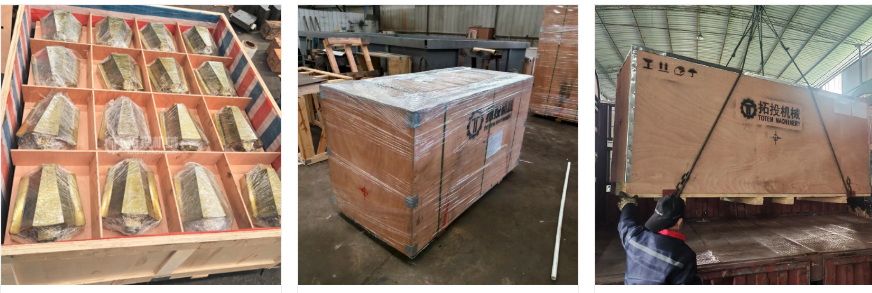
We understand that heavy-duty and high-precision components require robust protection during international transit. Our export-grade packaging system is meticulously designed in three specialized layers to safeguard your investment against mechanical impact and environmental factors:
Inner Protective Layer (Corrosion Prevention): All critical machined surfaces, mating interfaces, and end faces are thoroughly treated with premium anti-rust oil. The components are then tightly wrapped in VCI (Volatile Corrosion Inhibitor) paper. This creates a highly effective barrier against air and moisture, preventing rust and corrosion even during extended maritime shipping or long-term warehouse storage.
Cushioning & Fixation Layer (Impact Absorption): To neutralize transit vibrations and prevent shifting, we utilize high-density pearl cotton, industrial foam, and heavy-duty rubber pads. Custom-designed structural supports and positioning blocks are precisely fitted inside the packaging to lock the dynamic balancing weights securely in place, preventing any internal rolling or collision.
Outer Reinforced Packaging (Structural Integrity): The exterior utilizes highly durable, reinforced export wooden cases engineered for exceptional load-bearing capacity. These heavy-duty enclosures are built to withstand the rigors of sea, land, or air freight. To guide safe handling at ports and project sites, we clearly apply essential shipping marks, including center of gravity indicators, designated lifting points, moisture protection warnings, and anti-tilt symbols.
Every project has unique logistical demands. We offer fully customized packaging configurations tailored to your specific requirements. Whether you need enhanced protection levels for extreme climates, specialized cushioning methods, unique fixing structures, or custom outer case designs, we adapt our packaging strategies to match your transportation conditions, destination port regulations, and on-site unloading capabilities.
To ensure your project timeline is strictly met, we provide flexible and reliable global shipping options. Whether you require expedited air freight for urgent replacements or cost-effective sea freight for bulk orders, our logistics team coordinates the optimal route. We offer comprehensive shipment tracking and dedicated after-sales support, guaranteeing that your dynamic balancing weights are delivered safely, efficiently, and on schedule to your facility or global project site.
Whether you require standard machined balancing weights, custom OEM components for your equipment manufacturing line, or a complete supporting solution for your thrust bearing systems, our dedicated engineering and manufacturing teams are ready to assist you. Send us your technical drawings and project requirements today, and we will provide a detailed, highly competitive quote alongside a tailored delivery solution within 24 hours.


