


| Material: | |
|---|---|
| Quantity: | |
TOTEM MACHINERY’s bearing base, typically made of 08MnCuNiV cast steel due to its excellent impact resistance and corrosion resistance—making it particularly suitable for marine environments—is the core load-bearing component of the white metal bearing system. It is primarily used to install and support the white metal bearing bushings, and stably transmit the loads generated by the shaft system during operation to the equipment foundation or base structure.
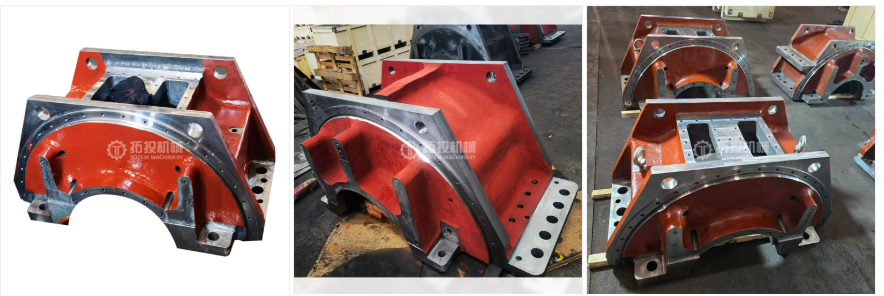
This high-capacity thrust bearing pad base ring receives axial loads transmitted through thrust pads during equipment operation, and evenly distributes these loads to the bearing housing or equipment foundation. It maintains precise positional alignment of thrust pads and balance blocks, ensures system coaxiality, eliminates local stress concentration, and directly determines the operational safety and service life of the entire thrust bearing system.
Engineered for continuous heavy-load operation, our 08MnCuNiV thrust pad base ring delivers exceptional structural rigidity, wear resistance, and anti-deformation performance, maintaining dimensional stability even under fluctuating working conditions. Precision machining ensures perfect assembly compatibility with mating components, reducing installation difficulty and improving the overall reliability of the bearing system.
Parameter | Standard Specification |
Core Material | 08MnCuNiV |
Hardness Range | 22-26 HRC (fully customizable) |
Coaxiality Tolerance | ±0.008mm |
Outer Diameter Range | 100mm × 1200mm (customizable per drawing) |
Applicable Temperature Range | -30℃ × 320℃ |
Surface Treatment | Precision Finishing + Anti-rust Protection |
Flatness Tolerance | ≤0.006mm |
Max Adaptable Radial Load | Up to 3000kN (customizable per design) |
Compatible Components | Thrust Pads, Balance Blocks, Thrust Bearing Housings |
Our industrial thrust pad base ring is widely adapted in thrust bearing devices across heavy industrial sectors, including marine propulsion systems, large steam turbines, hydro turbines, industrial fans, heavy-duty compressors, metallurgical equipment, mining machinery, and petrochemical pump sets.
It is optimized for high-load, long-term continuous operation, adapting seamlessly to harsh environments such as high dust, high humidity, and medium-to-high temperature working conditions, with stable performance under variable load impacts.
We select premium 08MnCuNiV for this base ring, which offers excellent strength, toughness, machinability, and wear resistance, perfectly meeting the rigidity and load-bearing requirements of thrust bearings under heavy-load continuous operation.
The manufacturing process starts with precision clamping and positioning using dedicated fixtures to ensure the stability of machining references and strict coaxiality control. We then perform precision machining and standardized chamfering on all edges and assembly surfaces to eliminate sharp edges and burrs, reduce stress concentration, and provide optimal assembly conditions for subsequent thrust pad and balance block installation.
TOTEM MACHINERY provides customized machining and co-design services for our steel thrust bearing base ring, based on customer-provided drawings and technical parameters. During the design phase, we fully consider axial load distribution, thermal deformation effects, and long-term operational stability, optimizing the structural layout to reduce local stress concentration and improve overall load-bearing reliability.
We also offer full system supporting components, including thrust pads, balance blocks, thrust shafts, white metal bearing bushes, bearing housings, and lubrication system parts, to deliver a one-stop solution for your thrust bearing system.


We adopt a multi-layer protective packaging solution for global long-distance transportation:
Inner Protective Layer: All precision machined surfaces, mating surfaces, and end faces are coated with professional anti-rust agent and wrapped with VCI anti-corrosion paper to isolate air and moisture.
Shock Absorption & Fixation Layer: Full-wrap pearl cotton, high-density foam, and custom anti-deformation support blocks absorb impact and prevent rolling and displacement during transit.
Outer Reinforced Layer: Heavy-duty export wooden cases with high structural strength and load-bearing capacity, suitable for sea, land, and air transportation.
Handling marks such as center of gravity, lifting points, and moisture-proof signs can be added according to customer requirements, with tailor-made packaging solutions available to meet specific transportation, destination port, and project site needs.
As a professional manufacturer of industrial thrust bearing foundational components, TOTEM MACHINERY has accumulated decades of heavy-duty component machining experience, a strict full-process quality control system, and a professional engineering team to deliver high-precision products compliant with international standards.
We provide not only custom machining services, but also full-system thrust bearing solution support for heavy equipment manufacturers and industrial operators, helping you reduce procurement costs, shorten project cycles, and improve the long-term operational reliability of your core equipment.


