| Quantity: | |
|---|---|
The Integrated Matched Thrust Bearing Balance Block & Base Ring Assembly is a system-level core component set, consisting of a precision 38CrNi3MoV dynamic balance block and a high-rigidity 35 steel thrust pad base ring, engineered for heavy-duty tilting pad thrust bearing systems. Unlike single component procurement, this pre-matched assembly is designed with unified machining standards and structural compatibility, providing a one-stop solution for industrial clients to optimize the overall performance, assembly efficiency, and operational stability of their thrust bearing systems.
This matched thrust bearing balance block and base ring set achieves perfect synergy between load distribution and transmission: the base ring provides a uniform, rigid mounting foundation for axial load transmission, while the paired balance block fine-tunes the internal stress state of thrust pads, eliminating local load concentration and ensuring consistent force across the entire bearing system.
Manufactured under unified dimensional standards and tolerance control, the thrust bearing system supporting components eliminate assembly mismatch issues caused by separate component procurement, significantly reducing on-site assembly time, debugging costs, and the risk of operational failures caused by poor fitting.
The paired assembly is optimized for collaborative operation under heavy load, high-speed, and variable working conditions, effectively suppressing operational vibration, reducing component wear, and extending the service life of the entire thrust bearing system by over 20% compared to unmatched single components.
Parameter | Balance Block Component | Base Ring Component |
Core Material | 38CrNi3MoV Alloy Steel | 35 High-Strength Carbon Steel |
Hardness Range | 280-320 HB | 220-260 HB |
Dimensional Tolerance | ±0.005 mm | ±0.01 mm |
Critical Surface Flatness | ≤0.002 mm/100×100 mm | ≤0.003 mm/100×100 mm |
Coaxiality Tolerance | - | ≤0.008 mm |
Applicable Temperature Range | -40℃ to 350℃ | -30℃ to 300℃ |
Customization Scope | Full matched customization per customer system drawings | Full matched customization per customer system drawings |
This integrated thrust bearing assembly set is specially designed for industrial clients with high requirements for bearing system stability, including marine propulsion system manufacturers, power generation equipment producers, hydro turbine and steam turbine operators, metallurgical machinery factories, and large-scale industrial rotating equipment suppliers. It is suitable for harsh operating scenarios such as long-term continuous operation, heavy load impact, high temperature, and high humidity environments.

The paired assembly adopts optimized material matching: the balance block uses 38CrNi3MoV high-toughness alloy steel for excellent fatigue resistance under dynamic load, while the base ring uses 35 high-rigidity carbon steel for stable structural support under static and dynamic heavy loads. All components are manufactured under a unified precision machining system, with dedicated fixtures for paired clamping and machining to ensure 100% fitting compatibility. The process includes 5-axis CNC precision machining, standardized chamfering, ultrasonic cleaning, and anti-rust treatment, with full-process inspection to ensure compliance with unified technical standards.
We provide fully customized matched machining services for the thrust bearing balance block and base ring assembly based on customer-provided thrust bearing system drawings, working condition parameters, and technical requirements, ensuring perfect compatibility with all mating components in the bearing system. Beyond the paired assembly, we offer full system supporting solutions, including matched thrust pads, thrust shafts, white metal bearing bushes, bearing housings, and oil supply semi-rings, delivering a complete, ready-to-assemble thrust bearing system for our clients.


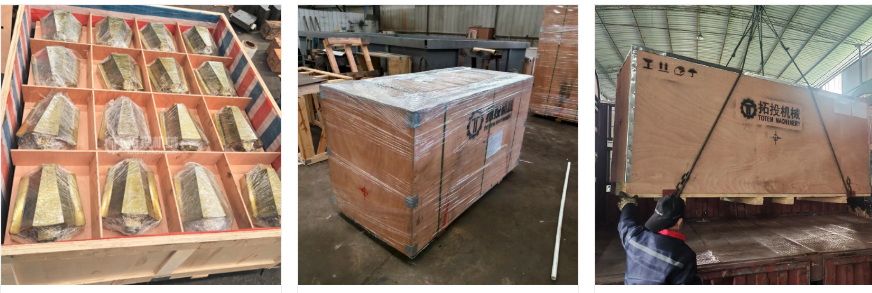
We adopt a specialized paired packaging solution for the integrated assembly:
1) Inner layer: Each component is individually coated with anti-rust oil, wrapped with VCI anti-corrosion paper, and marked with matching codes;
2) Buffer layer: Customized pearl cotton and positioning slots are used to fix the paired components, preventing collision and displacement during transportation;
3) Outer layer: Reinforced export wooden case with integrated fixation, suitable for sea, land, and air global transportation, with customizable handling marks and packaging solutions as required.
TOTEM MACHINERY is a professional system-level bearing component solution provider for industrial clients, with comprehensive design, machining, and testing capabilities. Unlike single component manufacturers, we focus on the overall operational performance of the bearing system, providing unified design, matched machining, full-process quality control, and responsive technical support. We can not only provide matched component sets according to your drawings, but also deliver full bearing and lubrication system overall solutions, helping you reduce procurement costs, improve assembly efficiency, and ensure long-term stable operation of your equipment.