


| Quantity: | |
|---|---|
The 35 Steel Thrust Bearing Pad Base Ring is a fundamental load-bearing and positioning component designed for heavy-duty thrust bearing systems, also widely referred to as a thrust pad support ring for industrial rotating equipment. As the core installation foundation of thrust bearing assemblies, this component is responsible for supporting, positioning, and fixing thrust pad components, while uniformly transmitting axial loads from thrust pads to the bearing housing or equipment foundation. Its structural rigidity and machining accuracy directly determine the operational safety and service life of the entire thrust bearing system.
This wear-resistant 35 steel base ring for thrust bearings provides a rigid, high-precision mounting base for thrust pads, ensuring that axial loads generated during equipment operation are evenly distributed across the entire ring structure, avoiding stress concentration and structural deformation under heavy load conditions.
With strict coaxiality and dimensional tolerance control, the 35 steel thrust bearing pad base ring ensures accurate positioning of all thrust pads and matching components, maintaining the correct positional relationship between moving and stationary parts during high-speed rotation, and improving the overall assembly efficiency of the bearing system.
Engineered for continuous operation under heavy load and variable working conditions, the component delivers exceptional anti-deformation and anti-fatigue performance, reducing maintenance frequency and operational costs for industrial equipment operators.
Parameter | Standard Value |
Core Material | High-Quality 35 Carbon Steel |
Hardness Range | 220-260 HB |
Outer Diameter Range | 100 mm to 1200 mm (customizable) |
Dimensional Tolerance | ±0.01 mm |
Coaxiality Tolerance | ≤0.008 mm |
Surface Roughness | Ra ≤1.6 μm |
Applicable Temperature Range | -30℃ to 300℃ |
Customization Scope | Full structural and dimensional customization per customer drawings |
This high-capacity thrust pad base ring is widely used in thrust bearing devices across core industrial sectors, including marine propulsion systems, industrial steam turbines, hydro turbines, power generation equipment, metallurgical machinery, and large-scale industrial rotating equipment. It is specially optimized for heavy load, long-term continuous operation scenarios, and can be adapted to harsh environments such as high humidity, high temperature, and mild corrosive conditions through customized surface treatment.

We select premium 35 high-strength carbon steel for this base ring, which offers excellent structural rigidity, machinability, and welding performance, perfectly meeting the strength and stability requirements of thrust bearings under heavy load and continuous operation. The manufacturing process starts with precision clamping and positioning using dedicated fixtures to ensure strict coaxiality and machining reference stability. We then perform precision turning, milling, and standardized chamfering treatment on all assembly surfaces, eliminating sharp edges and burrs, reducing stress concentration, and providing optimal structural conditions for subsequent assembly of thrust pads and balance blocks.
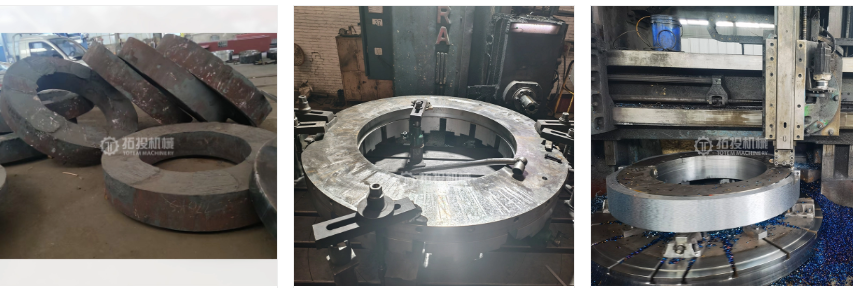
We provide customized design and machining services for the 35 steel thrust bearing base ring based on customer-provided drawings, technical parameters, and actual working condition requirements, ensuring a perfect fit with matched thrust pads, balance blocks, and bearing housings. In addition to single base ring manufacturing, we offer full system supporting solutions for thrust bearing assemblies, including matched thrust pads, balance blocks, thrust shafts, white metal bearing bushes, bearing housings, and oil supply components, all manufactured under unified machining standards for optimal system compatibility.
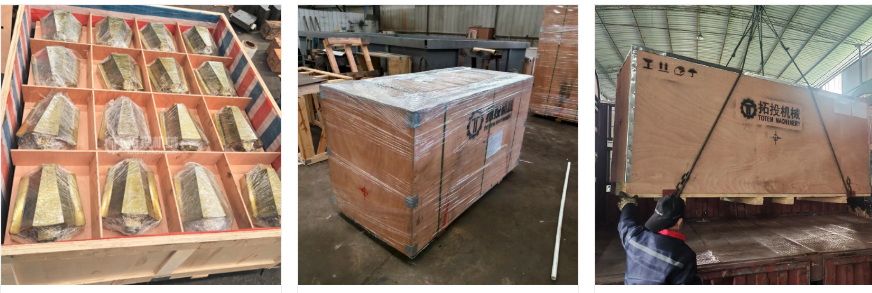
To ensure the product remains intact during long-distance global transportation, we adopt a 3-layer export-grade packaging system: 1) Inner protective layer: All machined and mating surfaces are coated with anti-rust oil and wrapped with VCI anti-corrosion paper to isolate air and moisture; 2) Cushioning and fixation layer: Full-wrap pearl cotton, foam pads, and custom internal positioning supports are used to prevent displacement and impact damage; 3) Outer reinforced packaging: Heavy-duty export wooden case with sufficient load-bearing capacity, suitable for sea, land, and air transportation, with customizable handling and warning marks as required.
TOTEM MACHINERY is a trusted precision component manufacturer for industrial equipment manufacturers and engineering procurement contractors, with mature machining capabilities, a strict full-process quality control system, and systematic bearing design expertise. We focus on delivering high-precision, high-reliability bearing components that meet international industrial standards, with flexible customization services, responsive technical support, and global shipping capabilities to support your projects worldwide.


