
Views: 0 Author: Site Editor Publish Time: 2026-07-01 Origin: Site
A marine propeller shaft is much more than a simple mechanical cylinder. It acts as the critical single point of failure between a vessel's prime mover and its hydrodynamic thrust. When this massive component breaks down, the operational stakes are enormous. Shaft failure or slight misalignment quickly leads to catastrophic downtime. You face expensive emergency drydocking and devastating lost revenue. Ships simply cannot afford propulsion paralysis out on the open water.
Therefore, evaluating replacement parts or custom-forged shafts requires rigorous technical knowledge. You must understand the exact metallurgical properties, dimensional tolerances, and compliance standards necessary for reliable integration. Poorly specified shafts will wreck an entire drive train.
We will explore how these massive steel structures function under extreme stress. You will learn how to evaluate forging quality, maintain strict machining tolerances, and avoid catastrophic integration failures during your next drydocking project.
The propeller shaft (or tail shaft) is the final link in the drive train, transferring rotational force from the engine to the propeller while withstanding immense axial loads.
Reliable shafting systems rely on the precise alignment of interconnected marine propulsion system parts, including thrust blocks and intermediate linkages.
Procurement and evaluation must prioritize verifiable metallurgical standards (e.g., forged duplex stainless steel), non-destructive testing (NDT), and classification society approvals (ABS, DNV, Lloyd’s) over lowest-cost sourcing.
Industry professionals often refer to this component as the tail shaft. It represents the final, outboard segment of the vessel's driveline. The Propeller Shaft protrudes through the ship's stern tube. It connects the internal power generation systems directly to the external propulsion mechanisms.
This single piece of steel handles complex, simultaneous physical forces. First, it endures extreme torsional stress. When a massive diesel engine accelerates, it twists the shaft violently. Second, it faces severe bending stress. A heavy bronze propeller hangs off the aft end. This weight constantly pulls downward. Third, it handles massive axial loads. As the blades push water backward, the water pushes the vessel forward. The shaft must transmit this immense forward thrust without buckling.
These harsh operational realities highlight a major business problem. Many operators try to save money by under-speccing materials. Others accept poor machining tolerances. These decisions directly accelerate stern tube bearing wear. They lead to premature mechanical seal failure. When a seal fails, highly corrosive seawater floods into the bearings. Simultaneously, lubricating oil leaks into the ocean. This triggers massive environmental fines and immediate vessel groundings. Precision and strength are absolutely mandatory.
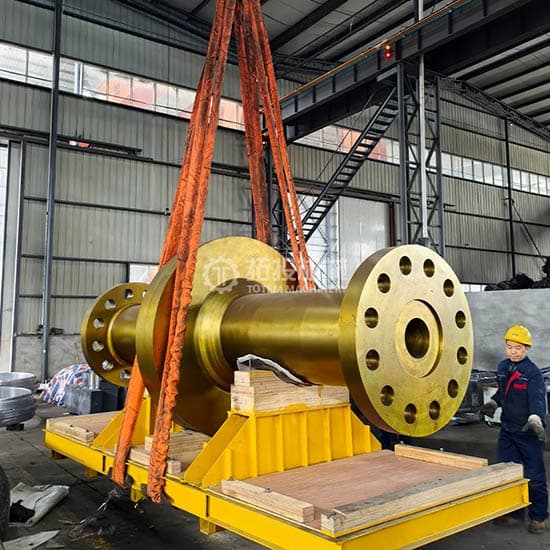
A propeller shaft never operates in isolation. It serves as the terminating component of a larger, highly calibrated kinetic chain. Engineers call this the driveline. Every single segment must operate in perfect unison. If one section falls out of alignment, the entire driveline suffers from destructive vibrations.
Power transmission begins right after the engine or gearbox. Here, we find a highly specialized component. The Marine Thrust Shaft plays a protective role. It transfers the massive forward thrust generated by the propeller directly into the ship's hull structure. It does this via a heavy-duty thrust block. This action protects the delicate engine crankshaft. If forward axial forces ever hit the engine directly, the crankshaft would shatter instantly.
Large commercial vessels have long engine rooms. You must span a significant physical distance between the main engine and the stern tube. We use the Intermediate Shaft to bridge this gap. Mid-to-large vessels often require several connected sections.
Implementation realities make this complex. The physical length and the number of intermediate sections directly dictate bearing alignment difficulty. Each coupling must sit perfectly straight. Every supporting line bearing must carry a specific load. A slight miscalculation here will cause severe operational vibrations down the line.
At the very end of the line, we reach the hydrodynamic interface. The shaft connects to the Marine Propeller. This connection point utilizes a precise taper, a heavy-duty keyway, and often a hydraulic nut. This ensures maximum surface contact. Absolute structural integrity is vital at this junction. If the taper fit lacks precision, the keyway will shear under heavy torque. The vessel will instantly lose all propulsion capabilities.
You must evaluate metallurgical properties carefully. Engineers select standard materials based on water salinity, vessel class, and operational profiles. Carbon steel represents a traditional choice. However, carbon steel rusts rapidly in seawater. Therefore, we protect carbon steel shafts using continuous bronze liners. Modern vessels often upgrade to duplex or super duplex stainless steels. These advanced alloys offer superior strength and natural corrosion resistance. High-performance boats frequently utilize Aqualoy materials.
Table: Common Shaft Material Comparisons
| Material Type | Primary Use Case | Corrosion Resistance | Fatigue Strength |
|---|---|---|---|
| Carbon Steel (Bronze Lined) | Large commercial cargo ships | Low (requires liner protection) | High |
| Aqualoy 22 (Stainless) | Workboats and patrol vessels | Excellent | Very High |
| Super Duplex Stainless Steel | High-load, harsh marine environments | Superior | Maximum |
Manufacturing methods matter deeply. You cannot cast a heavy-duty marine shaft. Casting often leaves microscopic internal voids. Instead, custom forging remains absolutely non-negotiable for high-load commercial applications. Forging presses hot steel into shape. This process creates a continuous grain flow. The internal steel grains align perfectly with the external geometry. This structural alignment dramatically increases fatigue limits.
We must apply a skeptical lens during procurement. Vendors frequently claim their metals are completely "corrosion-proof." This is false. Galvanic corrosion remains a harsh reality in saltwater. Different metals react electrically when submerged together. You must manage this using sacrificial anodes. Furthermore, always demand verifiable Material Test Reports (MTRs). If a supplier cannot prove their steel's chemical composition, do not buy their products.
Machining precision defines operational success. Minor manufacturing deviations will cause severe headaches. Strict runout tolerances are critical. We often demand straightness tolerances down to 0.02mm. If a shaft bends even slightly, it will whip at high speeds. This whipping motion destroys bearings rapidly. Surface finish requirements also matter. A rough surface will tear lip seals apart. Taper accuracy must match the propeller hub perfectly.
Quality assurance protocols separate reliable manufacturers from dangerous ones. Mandatory testing protocols identify hidden flaws before installation. Subsurface micro-fractures can cause a shaft to snap cleanly in half under full load.
We require the following non-destructive testing (NDT) methods:
Ultrasonic Testing (UT): Technicians use high-frequency sound waves. These waves penetrate deep into the steel to detect internal voids.
Magnetic Particle Inspection (MPI): Inspectors magnetize the component. They apply special particles to reveal invisible surface cracks.
Dye Penetrant Inspection (DPI): Workers apply visible or fluorescent dyes. This highlights microscopic surface defects on non-magnetic stainless alloys.
Regulatory compliance is equally crucial. You must source parts from manufacturers approved by the International Association of Classification Societies (IACS). Examples include ABS, DNV, and Lloyd’s Register. These societies set rigorous marine engineering standards. An uncertified driveline component represents a massive legal liability. It can void your vessel's insurance. It directly compromises the ship's fundamental seaworthiness.
Replacing components during drydock presents unique implementation risks. You cannot simply pull out an old piece of steel and slide a new one in. Alignment complexities always arise. The ship's hull flexes naturally over time. If you replace a single shaft, you must re-evaluate the entire driveline alignment. We highly recommend utilizing modern optical or laser alignment tools. This ensures all bearings share the load equally.
Bearing and seal compatibility also require careful attention. Suppose you upgrade your steel grade. You might change the overall diameter slightly. You must recalculate clearance tolerances immediately. Stern tube bearings utilize oil or seawater for cooling. If clearances shrink too much, bearings will overheat. If clearances grow too large, severe vibrations will occur.
You need a logical framework for shortlisting vendors. Buying critical Marine Propulsion System Parts requires due diligence.
Verify custom forging capabilities: Ensure they possess heavy hydraulic presses capable of achieving continuous grain flow.
Check for comprehensive manufacturing: Ask if they can supply complete shaft lines internally, avoiding third-party assembly risks.
Demand rigorous QA documentation: They must provide full lifecycle documentation, including MTRs and dimensional inspection reports.
Confirm classification society approvals: Only work with facilities actively certified by major IACS members.
The propeller shaft represents a high-stakes engineering investment. It requires rigorous oversight from procurement to installation. A failure here paralyzes the entire vessel. You cannot rely on cheap alternatives or unverified suppliers.
Evaluating any driveline component must remain an objective process. Base your decisions on data-backed forging capabilities. Demand strict adherence to IACS standards. Prioritize proven operational longevity over initial procurement savings. A properly forged and machined unit will last for decades.
As a crucial next step, encourage your technical team to consult with specialized marine engineering firms. You need experts to specify exact load requirements, calculate precise alignment offsets, and choose the correct material grades for your next drydock or new build project.
A: They differ primarily in location and load profile. The propeller shaft sits outside the hull and protrudes through the stern tube. It connects directly to the propeller. It faces seawater exposure and severe bending forces. The intermediate shaft remains entirely inside the hull. It simply spans the distance between the thrust block and the propeller shaft, transferring pure rotational torque.
A: Standard classification society rules dictate strict timelines. You must typically perform a comprehensive tail shaft survey every 3 to 5 years during drydocking. Inspectors withdraw the shaft to check for corrosion and fatigue cracking. However, vessels utilizing approved condition-monitoring systems for oil and bearings can occasionally extend these traditional inspection intervals.
A: A tapered end provides a massive mechanical advantage. When combined with a keyway or a hydraulic nut, the taper ensures maximum surface contact area between the steel and the propeller hub. This friction-fit guarantees secure torque transfer. It also ensures absolute concentricity, preventing vibrations as the heavy bronze blades spin at high speeds.


