| Availability: | |
|---|---|
| Quantity: | |
The Grooved Hardened Oil Supply Ring is an irreplaceable core component of the thrust bearing in marine propulsion systems, working in tandem with thrust shafts, bearing pads, and lubrication systems to form a stable, uniform oil film between rotating shafts and bearing working surfaces. As a specialized Heavy-Duty Oil Supply Ring for High-Speed Rotating Machinery, this product is engineered to deliver consistent lubrication under extreme high-speed, high-load operating conditions, effectively reducing friction and abnormal wear, and significantly extending the service life of thrust bearings and supporting shafting systems. Our precision-machined Rotating Oil Ring for Marine Thrust Bearing fully complies with international marine engineering standards, and can be adapted to the most demanding working environments.
The precision grooved structure of our High-Speed Machinery Oil Supply Ring achieves uniform oil distribution even at rotation speeds up to 15000 RPM, eliminating oil film breakage and ensuring continuous lubrication of the bearing working area.
Through professional surface hardening processes, the oil ring achieves a surface hardness of 45HRC-58HRC, effectively resisting abrasive wear caused by long-term high-speed rotation and maintaining dimensional stability over tens of thousands of hours of operation.
The product is designed with targeted anti-corrosion properties, adapting to the humid, high-salt marine environment and ensuring stable performance even under long-term exposure to seawater vapor.
Parameter | Standard Value |
Inner Diameter Range | 80mm × 1200mm |
Core Material | High-Strength Alloy Steel / Corrosion-Resistant Steel |
Surface Hardness | 45HRC × 58HRC (after hardening) |
Groove Structure | Custom Precision Grooved Design |
Maximum Applicable Rotation Speed | 15000 RPM |
Roundness Tolerance | ≤0.005mm |
Surface Roughness | Ra ≤0.4μm |
Non-Destructive Testing | 100% Ultrasonic Testing (UT) Compliant |
This Hardened Oil Supply Ring is primarily adapted to marine propulsion systems, high-speed industrial rotating equipment, steam turbines, gas turbines, hydroelectric generating units, and heavy-duty compressors. It is specially optimized for marine engineering, ocean-going vessels, offshore platforms, and high-speed power generation equipment, meeting the strict requirements of long-term continuous operation in harsh industrial and marine environments.

We select high-strength alloy steel or corrosion-resistant steel as the base material, with professional anti-rust treatment on the surface. The machining process focuses on strict control of the dimensional accuracy, roundness, and surface roughness of the inner bore and oil grooves, using precision boring, CNC grinding, and surface hardening processes to ensure uniform oil distribution and stable fitting with the thrust bearing system. Each process is subject to full-process dimensional monitoring to avoid machining deviations.
We provide custom design and manufacturing of Grooved Oil Supply Rings based on different ship types, shaft diameters, and load conditions. In addition to single oil ring products, we can also manufacture a full set of marine propulsion system core components, including thrust shafts, thrust bearing assemblies, intermediate shafts, sliding bearing assemblies, and propeller shaft assemblies, providing a complete solution from single components to the entire propulsion shafting system.

After machining, each oiler disc undergoes rigorous quality inspection. This includes measurements of dimensional and fit accuracy, surface quality checks, ultrasonic testing (UT), and inspection of the anti-rust coating, ensuring that the rotating oil ring can maintain stable performance even under prolonged exposure to seawater.
Relying on mature machining processes and inspection systems, our oil rings meet the requirements of thrust bearings for various ship types and high-load operating conditions. Products can be manufactured according to drawings or customized to meet the application needs of different thrust bearing systems.
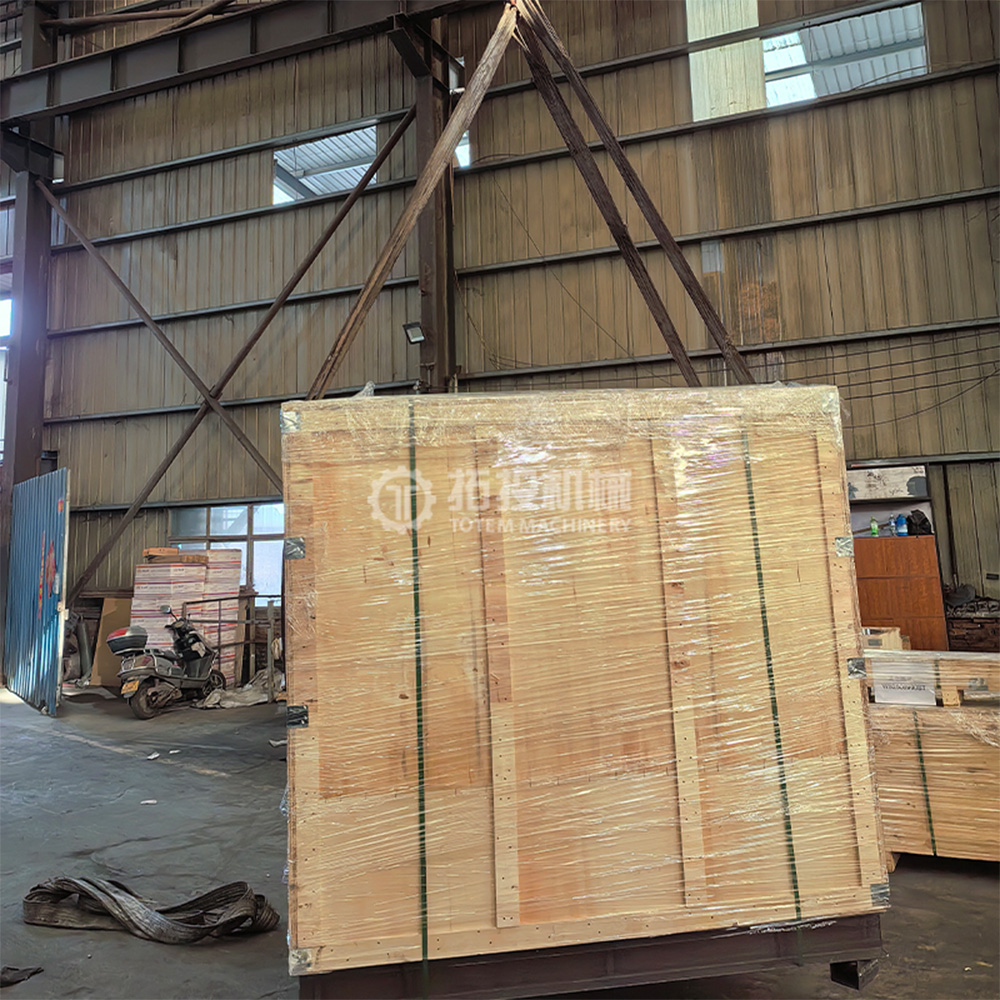
All critical surfaces of the product are coated with anti-rust oil, wrapped with VCI anti-corrosion paper to isolate air and moisture. The product is fixed with custom positioning blocks inside the package, surrounded by pearl cotton and foam cushioning materials to absorb vibration and impact. The outer packaging adopts reinforced export wooden cases, suitable for long-distance ocean shipping, and can be added with handling marks such as lifting points and moisture protection signs according to customer requirements.
TOTEM MACHINERY has mature machining processes and a complete quality inspection system, with years of supporting experience for marine engineering and heavy-duty equipment manufacturers. Our oil rings fully meet the requirements of various ship types and high-load operating conditions, with strict quality control throughout the production cycle. We provide one-stop custom solutions, professional technical support, and stable delivery capabilities, becoming a trusted long-term partner for industrial clients worldwide.

Evaluate marine propeller shafts with our expert guide. Avoid catastrophic downtime due to misalignment or poor forging. Learn about materials, tolerances, and compliance.
Avoid propeller shaft failure. Guide to sizing, forged materials, and OEM machining for marine propulsion, securing 30-year reliability.
Avoid costly propeller shaft breakdowns. Expert guide to custom alloys, precise machining, and vetting manufacturers for marine propulsion.
Distinguish thrust shafts from propeller shafts to prevent catastrophic marine failures. Compare axial vs. torsional loads, materials, and maintenance to cut downtime.
Precision shaft machining prevents catastrophic misalignment at sea. Discover critical tolerances and supplier vetting for reliable propulsion.
This article analyzes small crankshaft manufacturing for reciprocating compressors. These core components endure alternating loads over 200 MPa, speeds to 3000 r/min, thin oil film, and -20 to 80°C temperatures. Material choice prioritizes 40CrNi2MoA for fatigue strength, with 42CrMo as economic alternative. Process includes die forging (ratio >=3), quenching/tempering to 28-34 HRC core, surface hardening to 54-58 HRC, and precision machining to IT7, Ra <=0.4 μm. Quality control covers dimensions, hardness, MPI, UT, with three-level inspection. Failure prevention targets fatigue, wear, cracking, and imbalance. A case study achieved 99.5% yield. Cost breakdown shows machining as largest share; batch optimization and near-net-shape forging reduce costs. Trends include laser hardening, 3D repair, in-process sensing, composites, and green quenchants. Zero-defect production integrates materials, heat treatment, precision machining, and quality management for reliable compressor operation.
Source reliable marine propeller shafts to avoid costly downtime. Discover precision tolerances, anti-corrosion alloys, and vendor validation.
Ensure reliable marine propulsion shafts. Learn how forged 38CrNi3MoV alloys and ultrasonic testing prevent catastrophic failures and downtime.
Prevent costly propulsion failures. Learn how to evaluate and procure reliable marine thrust pad bearings to maximize vessel uptime and reliability.
Prevent drydock downtime. Learn to source reliable OEM marine thrust shafts by evaluating forging quality, dynamic balancing, and compliance.
The intermediate shaft stands as the critical bridge between the propulsion shaft and the propeller shaft in a marine shafting line. When components spin at high velocities under immense torque, this connection bears the brunt of the mechanical forces.
This project supplies critical spare parts for petrochemical unit overhauls. Units operate under extreme conditions. As maintenance shifts to condition-based, spare shortages cause 15% of downtime. We integrate data analysis (vibration, temperature, corrosion), precision forging, five-axis machining, HVOF/laser cladding, and SPC (Cpk≥1.33) to produce four lines: compressor impellers/rotors, pump parts, reciprocating components, and high-temperature valves. Blockchain MES ensures traceability. Agile scheduling cuts lead times 20-30%. LCC savings exceed 15%. We provide failure analysis (SEM/EDS) and root-cause advice. This replaces imports, boosts reliability, and makes us a health partner.
Marine Propulsion System Shafting is the core component of ship power propulsion systems, and its technological advancement directly determines propulsion efficiency, operational safety, and economic performance. This paper systematically reviews the design theory, key components, new materials, vibration control, and intelligent monitoring technologies of marine propulsion system shafting, covering critical technical domains including shafting alignment, vibration control, carbon fiber reinforced polymer (CFRP) composite drive shafts, water-lubricated bearing materials, and digital twin monitoring. Intelligent monitoring systems integrating multi-parameter sensors — vibration, temperature, strain, and oil condition — are examined in the context
Compare Babbitt vs. roller bearings. Learn how load, speed, and maintenance dictate selection to optimize heavy machinery reliability.
Learn to vet Babbitt metal manufacturers. Ensure ASTM B23 compliance, alloy purity, and quality control to prevent critical machinery downtime.
Comprehensive guide to Babbitt bearings. Learn about hydrodynamic lubrication, alloy selection, casting methods, failure analysis, and sourcing.
Learn to select the right Babbitt bearing. Compare tin vs. lead alloys, evaluate engineering parameters, and ensure quality foundry practices.
A reciprocating compressor is a critical industrial machine that converts mechanical energy into gas pressure energy. It is widely used in industries such as petrochemicals, food and pharmaceuticals, electronics and semiconductors, and hydrogen energy.In March 2026, a Chinese manufacturer successfully achieved mass production of a Class 0 oil-free reciprocating compressor, breaking the long-standing monopoly of overseas companies in high-end oil-free sealing technologies.
As industrial digitalization and intelligent transformation accelerate, the reciprocating compressor, as a core piece of equipment in industrial production, has become a key focus for enterprises seeking higher operational efficiency and improved system reliability.
Within the massive framework of heavy machinery, white metal bearings have always served as the "anchor of stability." From the propulsion shaft systems of ten-thousand-ton vessels to the runner brackets of large-scale hydroelectric turbines, this Babbitt alloy—composed of tin, antimony, and copper—