
Views: 0 Author: Site Editor Publish Time: 2026-08-24 Origin: Site
The piston rod in a reciprocating compressor connects the crosshead to the piston head, transmitting axial force through every compression cycle. When it fails, the compressor stops. A broken rod can damage the cylinder liner, destroy the packing system, and contaminate the gas stream with debris. For facilities running high-pressure gas compression in petrochemical, shale gas, or chemical processing applications, a single piston rod failure can mean days of unplanned downtime and significant repair costs.
Understanding why piston rods fail is the first step in preventing failures. This guide covers the main failure mechanisms, how to recognize early warning signs, and what maintenance and procurement decisions actually reduce risk over the long term.
The most common causes of reciprocating compressor piston rod failure are:
Fatigue cracking from cyclic tensile and compressive loads at stress concentration points
Misalignment between the piston rod, crosshead, and cylinder centerline causing uneven loading
Surface damage including scoring, galling, and pitting from poor lubrication or contamination
Corrosion from aggressive gas compositions attacking the rod surface or stuffing box area
Overload from abnormal operating conditions such as liquid carryover, valve failure, or pressure spikes
Packing wear allowing gas leakage that erodes the rod surface over time
Most failures involve more than one factor. A misaligned rod accelerates packing wear, which lets corrosive gas contact the surface, which initiates fatigue cracks. Catching any one of these early can break the chain.
The piston rod is a precision round shaft that connects the forged compressor piston rod assembly to the crosshead on one end and the compressor piston head on the other. During each rotation of the crankshaft, the rod transmits reciprocating motion and mechanical force to the piston head, which compresses gas inside the cylinder. The rod passes through the stuffing box, where packing rings form a dynamic seal that prevents high-pressure gas from escaping into the crankcase.
This means the rod simultaneously handles three jobs: transmitting axial force, maintaining dynamic seal integrity with the packing system, and preserving alignment between the piston and cylinder. A failure in any of these functions can trigger a cascading problem.
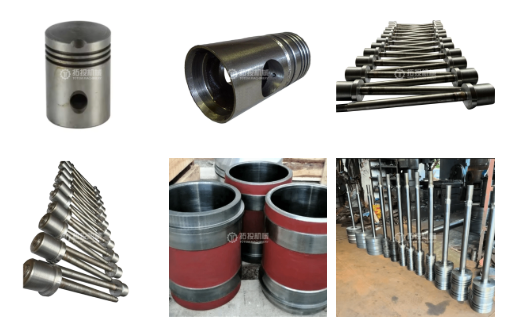
Fatigue is the leading cause of piston rod failure. Every compression cycle applies alternating tensile and compressive stress to the rod. Over millions of cycles, microcracks can initiate at stress concentration points: thread roots, fillet radii, diameter transitions, and surface defects. Once a crack starts, it propagates with each cycle until the remaining cross-section can no longer carry the load and the rod fractures.
Several factors accelerate fatigue cracking. A rod surface with machining marks or grinding burns acts as a crack initiator. Thread connections with insufficient fillet radii concentrate stress at the root. Heat treatment that leaves residual stress in the surface layer reduces fatigue life. And corrosive environments lower the fatigue limit by attacking the surface and creating pit-initiated cracks.
When the piston rod, crosshead, and cylinder are not perfectly coaxial, the rod experiences bending stress in addition to axial load. This bending stress alternates with each stroke, accelerating fatigue. Misalignment also forces the packing to work harder on one side, causing uneven wear that lets gas leak past the rod. That leakage can erode the rod surface and raise local temperature, creating a feedback loop that shortens rod life.
Common sources of misalignment include improper assembly, thermal growth mismatch between the cylinder and frame, foundation settling, and worn crosshead guide clearances. The compressor crosshead assembly plays a direct role here: if the crosshead guide is worn or the crosshead pin clearance is excessive, the rod path deviates from the cylinder centerline.
The rod surface that passes through the packing system must maintain a precise finish and hardness. Any damage to this surface degrades the packing seal and accelerates rod wear. Scoring can occur when solid particles enter the stuffing box from dirty gas, failed lubrication, or debris from upstream component failure. Galling happens when the rod and packing materials interact under high contact pressure without adequate lubrication film. Pitting from corrosion creates stress risers that initiate fatigue cracks.
Gas compositions containing hydrogen sulfide, carbon dioxide, chlorides, or moisture can attack the rod surface directly or through the packing interface. Sulfide stress cracking and hydrogen embrittlement are specific risks in sour gas service. Even in nominally dry gas applications, condensation during shutdowns or temperature transients can introduce moisture that corrodes the rod surface in the stuffing box area.
Liquid carryover into the cylinder creates hydraulic load that can exceed the rod's yield strength in a single cycle. A failed discharge valve that allows full differential pressure to act on one side of the piston creates unbalanced loading. Pressure spikes from rapid valve closing, piping resonance, or process upsets can produce transient loads well above the design envelope. Any of these events can bend the rod, damage the thread connection, or initiate a crack that later propagates by fatigue.
Piston rod failures rarely happen without warning. The following symptoms often appear before a catastrophic break:
Packing leakage increasing beyond normal vent rates, indicating rod surface wear or loss of alignment
Temperature rise at the stuffing box, suggesting friction from scoring, galling, or insufficient lubrication
Vibration changes at the crosshead or cylinder area, often pointing to developing misalignment or looseness
Unusual noise from the cylinder area, including metallic knocking that may indicate a loose piston nut or developing rod crack
Gas contamination in the crankcase or frame vent, indicating packing failure and rod surface damage
Visual surface defects detected during scheduled inspection: scoring, pitting, discoloration, or fretting at thread connections
Any of these signs warrants immediate investigation. Continuing to run a compressor with a suspected rod problem risks catastrophic failure that can damage the cylinder, piston, and valves.
| Failure Mode | Primary Causes | Prevention Measures |
|---|---|---|
| Fatigue cracking | Cyclic stress at stress concentration points; surface defects; inadequate heat treatment | Specify adequate fillet radii at thread roots; require surface finishing with controlled roughness; verify heat treatment eliminates residual stress; perform periodic NDT |
| Misalignment | Poor assembly; worn crosshead guides; foundation settling; thermal growth | Verify coaxiality during installation; monitor crosshead guide clearance; check alignment after foundation work; use laser alignment tools |
| Surface scoring | Contamination in stuffing box; failed lubrication; debris from upstream failure | Install proper gas filtration; maintain stuffing box lubrication; inspect packing condition; replace packing before surface damage occurs |
| Corrosion | Sour gas service; moisture condensation; incompatible rod material for gas composition | Specify corrosion-resistant material or surface treatment for the application; maintain purge gas during shutdowns; monitor gas composition changes |
| Overload | Liquid carryover; valve failure; pressure spikes; process upsets | Install liquid separation upstream; monitor valve performance; use pressure relief protection; train operators on shutdown procedures |
| Packing-related wear | Packing ring hardening; incorrect packing material; worn packing bore | Replace packing on schedule; match packing material to rod surface treatment; inspect rod surface during packing replacement |
Regular inspection is the most effective tool for preventing piston rod failure. The following methods, used individually or in combination, can detect developing problems before they lead to a break.
Visual inspection of the rod surface during scheduled shutdowns can reveal scoring, pitting, discoloration, and early-stage cracking. Use a borescope if the rod cannot be fully extracted. Dye penetrant testing (PT) detects surface-breaking cracks that are too small to see with the naked eye. Magnetic particle testing (MT) works on ferromagnetic rod materials and can find subsurface cracks near the surface.
Measure rod diameter at multiple points along the length to detect wear, taper, or bending. Check straightness using a dial indicator or laser alignment tool with the rod supported at its journal points. Any deviation from the original straightness tolerance indicates either permanent bending from overload or uneven wear from misalignment.
Ultrasonic testing (UT) can detect internal flaws or large cracks that have not yet reached the surface. This method is useful for rods with long service history where subsurface fatigue damage may be developing. For thread connections, eddy current testing can detect surface and near-surface cracks at thread roots that are difficult to inspect visually.
Online monitoring systems that track vibration at the crosshead and cylinder, plus temperature at the stuffing box, can detect developing problems while the compressor runs. A trend of increasing stuffing box temperature over weeks or months often precedes a rod surface failure. Changes in vibration signature at the crosshead may indicate developing misalignment or looseness that will eventually damage the rod.
The choices made when ordering a replacement piston rod have a direct impact on its service life. Several specifications deserve attention before placing an order.
The rod material must match the application. For standard shale gas and petrochemical service, forged alloy steel provides the strength and toughness needed for high-frequency cyclic loading. For sour gas applications, the material must meet the requirements of NACE MR0175 or equivalent standards, with controlled hardness to resist sulfide stress cracking. For corrosive environments, stainless steel or surface treatments such as nitriding can extend service life. The material certificate should be traceable to the specific rod.
The rod surface that contacts the packing requires specific hardness and surface finish to resist wear and maintain seal integrity. Hardened surfaces, whether through induction hardening, nitriding, or chrome plating, extend packing life and resist scoring. The surface roughness must be within the range specified by the packing manufacturer; too rough accelerates packing wear, too smooth prevents lubricant retention.
Straightness, roundness, and coaxiality directly affect rod performance. A rod manufactured with strict control over these parameters maintains stable axial precision during high-speed reciprocating motion, reducing the risk of off-center loading and abnormal packing wear. Critical reference surfaces should be established in a single setup, with multi-process precision machining and straightening operations that maintain dimensional integrity.
Require material certificates, heat treatment records, dimensional inspection reports, and NDT results with every rod shipment. This documentation supports root cause analysis if a failure occurs and ensures batch consistency for spare parts inventory. A supplier that provides full traceability demonstrates manufacturing discipline that extends to the product itself.
Shanghai TOTEM Machinery Co., Ltd. manufactures custom reciprocating compressor parts based on client drawings, including piston rods produced through integral forging with strict control over straightness, roundness, and coaxiality. The company provides full traceability documentation with each shipment. If you need a replacement rod or have experienced a failure and want to discuss material and manufacturing specifications, Contact Shanghai TOTEM Machinery for technical discussion.
Beyond procurement, ongoing maintenance practices determine how long a piston rod lasts in service. The following practices have the highest impact on rod longevity.
Replace packing rings on schedule, not after they fail. Hardened packing rings damage the rod surface. When replacing packing, inspect the rod surface for signs of wear, scoring, or heat discoloration. If the rod shows wear but is still within tolerance, reconditioning the surface can extend its life. If wear exceeds tolerance, replacing the rod before it fails catastrophically is far less expensive than dealing with a broken rod inside a running compressor.
Adequate lubrication between the rod and packing is critical. Too little lubrication causes galling and scoring. Too much can cause packing swelling and gas contamination. Monitor lubricant flow rates and quality. In oil-free compression applications, the rod surface treatment and packing material must be compatible for dry running.
Check rod alignment after any major maintenance event: cylinder replacement, crosshead replacement, packing overhaul, or foundation work. Use dial indicators to measure rod runout at the cylinder and crosshead ends. If runout exceeds the manufacturer's specification, correct the alignment before returning the compressor to service.
Install and maintain gas filtration upstream of the compressor. Particulate contamination in the gas stream can enter the stuffing box and score the rod. Liquid carryover can cause hydraulic overload. Monitor gas composition for changes that may introduce corrosive components requiring material or operational adjustments.
Reciprocating compressor piston rod failure is preventable in most cases. The key is understanding that failures develop over time through interacting mechanisms: fatigue, misalignment, surface damage, corrosion, and overload all feed into each other. Regular surface inspection, dimensional verification, NDT, and online monitoring catch problems early. Correct material selection, surface treatment, and manufacturing precision set the foundation for long service life. And disciplined maintenance of packing, lubrication, alignment, and gas quality keeps the rod operating within its design envelope. For facilities that depend on continuous gas compression, investing in high-quality replacement rods and proactive inspection is a straightforward way to avoid the far greater cost of unplanned downtime.
There is no fixed lifespan. Rod life depends on operating conditions, maintenance quality, and material selection. Under normal conditions with proper maintenance, a well-manufactured rod can serve for several years. Rods in corrosive service or under frequent overload may fail much sooner. Regular inspection is the only reliable way to assess remaining life.
Minor surface damage can sometimes be reconditioned by grinding or polishing to remove the defect, provided the finished diameter remains within tolerance and the surface treatment can be restored. Deep scoring, cracks, or bends require replacement. Any repair should include NDT verification that no cracks remain.
Increasing packing leakage and rising stuffing box temperature are the most common early indicators. These symptoms suggest rod surface wear, loss of alignment, or packing hardening. Investigating immediately can prevent catastrophic failure.
Not necessarily. If the original rod failed due to corrosion or fatigue, the replacement should use a material or surface treatment better suited to the actual operating conditions. Review the failure root cause and consult with the manufacturer to select the appropriate material specification.
The crosshead guides the piston rod and isolates lateral forces. If the crosshead guide clearance is excessive or the crosshead pin is worn, the rod path deviates from the cylinder centerline. This misalignment causes uneven packing wear, bending stress in the rod, and accelerated fatigue. Checking crosshead condition during rod inspection is essential.


