| Availability: | |
|---|---|
| Quantity: | |
Product Description
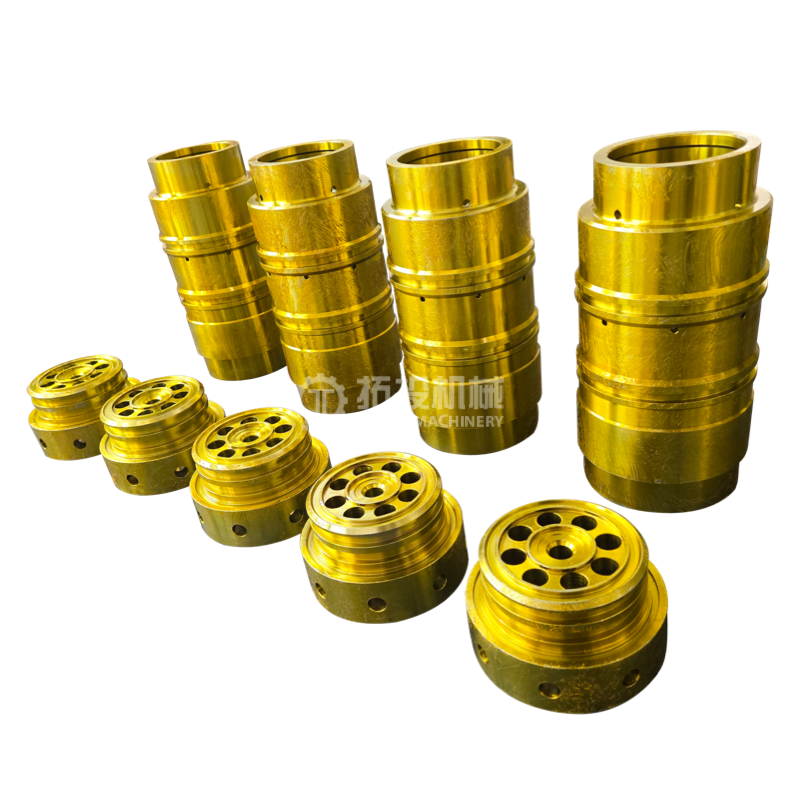
Compressor Inlet valve is also called suction valve.It installs in the compressor cylinder cover or valve chamber and also is the critical component to accomplish one-way gas inhalation.
During the piston's return stroke, when negative pressure forms inside cylinder, the valve plate automatically opens once the cylinder pressure falls below the intake chamber pressure and reaches the valve opening differential pressure, allowing gas to rapidly enter cylinder. At the beginning of piston compression stroke, the pressure inside the cylinder rises, and the valve plate quickly reseats and closes to prevent the gas that has been drawn in from flowing back into the intake pipeline.
The opening sensitivity、flow resistance, and closing response of intake valve directly determine the compressor's suction filling coefficient (volumetric efficiency), suction gas temperature rise, energy consumption, and valve component lifespan.
![]() | ![]() | ![]() |
![]() | ![]() | ![]() |
Our reciprocating compressor inlet valve faces medium and high frequency opening and closing conditions,establishing a comprehensive solution encompassing structural design, material heat treatment, precision manufacturing, and validation delivery, centered on “low pressure drop intake + rapid reseating + anti-rebound impact resistance + extended fatigue life.” It’s suitable for applications involving air、natural gas and various industrial process gases.It adopts the low-pressure-drop intake design and employs an intake duct matched to the effective suction plate valve orifice area, reducing intake pressure drop and turbulence losses while enhancing intake filling.
For varying speed/pressure ratio conditions, a valve lift window is configured to balance intake capacity with Inlet check valve block impact velocity control.Meanwhile,when processing to adopt high consistency sealing manufacturing.The sealing surface of Inlet valve seat adopts high precision machining and lapping processes to assure stable and low-leakage adhesion of suction port valve plate.Critical mating surfaces and dimensional tolerances are controlled, reducing the risk of off-center loading and localized hot spots while enhancing batch consistency.
When facing complicated operating conditions,we could adjust structural details and material solutions of Suction Reed Valve based on operating conditions such as dust-laden environments, oil mist exposure, or coking tendencies to reduce sticking and deposition sensitivity. Additionally, we support spare-parting and modular delivery for expedited on-site maintenance and periodic overhauls.
Packaging & Shipping
1. Inner Protective Layer
All critical surfaces of the product, such as machined areas, mating surfaces and end faces, are coated with anti-rust oil or other suitable protective agents. The parts are then wrapped with VCI (Volatile Corrosion Inhibitor) paper or similar protective materials to isolate air and moisture and reduce the risk of corrosion during transportation and storage.
2. Cushioning and Fixation Layer
Cushioning materials including pearl cotton, foam or rubber pads are applied around the product to absorb vibration and impact. According to the product structure, customized supports or positioning blocks are installed inside the package to prevent rolling or movement and to keep the product stable during transport.
3. Outer Reinforced Packaging
The outer packaging adopts a reinforced export wooden case or other high-strength packaging with sufficient load-bearing capacity, suitable for sea, land or air transportation. Handling marks such as center of gravity, lifting points, moisture protection and anti-tilt symbols can be added based on customer requirements for easier handling and identification on site.
4. Customized Packaging Options
Packaging solutions can be adjusted according to customer requirements, including protection level, cushioning method, fixing structure and outer case design, to suit different transportation conditions, destination ports and project site requirements.
Within the massive framework of heavy machinery, white metal bearings have always served as the "anchor of stability." From the propulsion shaft systems of ten-thousand-ton vessels to the runner brackets of large-scale hydroelectric turbines, this Babbitt alloy—composed of tin, antimony, and copper—
Learn how tilting pad bearings mitigate oil whirl, reduce power loss, and ensure high-speed stability in critical turbomachinery and industrial assets.
Learn how tilting pad bearings stabilize high-speed rotors, prevent oil whirl, and manage heat in critical industrial turbines and compressors.
Compare plain vs. tilting pad bearings. Learn to eliminate oil whirl and ensure rotordynamic stability for high-speed industrial turbomachinery.
Learn how tilting pad bearings neutralize oil whirl and rotor instability. Explore design variables and a retrofit guide for turbomachinery.
Master tilting pad bearings to prevent oil whirl and whip. Learn about LOP/LBP setups, lubrication, and specs for stable high-speed machinery.
White Metal Sliding Bearings—In-Depth Analysis Report on the Performance of Babbitt AlloysAbstract: This report conducts an in-depth analysis of the performance characteristics, application scenarios, economic benefits, and practical cases of different Babbitt alloys used in white metal journal bear
A reciprocating compressor is a critical industrial machine that converts mechanical energy into gas pressure energy. It is widely used in industries such as petrochemicals, food and pharmaceuticals, electronics and semiconductors, and hydrogen energy.In March 2026, a Chinese manufacturer successfully achieved mass production of a Class 0 oil-free reciprocating compressor, breaking the long-standing monopoly of overseas companies in high-end oil-free sealing technologies.
As industrial digitalization and intelligent transformation accelerate, the reciprocating compressor, as a core piece of equipment in industrial production, has become a key focus for enterprises seeking higher operational efficiency and improved system reliability.
A steam turbine is the core power equipment that converts high-temperature steam thermal energy into mechanical energy. It serves as a critical component in industries such as thermal power generation, nuclear energy, and petrochemicals.
Replacing a Thrust Bearing is often treated as a simple maintenance task, but in real industrial equipment it is rarely that simple.
Many bearing problems do not begin after months of operation. They begin on the day the part is installed.
A failing Thrust Bearing rarely goes from normal operation to complete damage in one step. More often, the warnings appear gradually: a little more heat, more noise, rougher running, or a small change in axial position.
White Metal Sliding Bearings—In-Depth Analysis Report on the Performance of Babbitt AlloysAbstract: This report conducts an in-depth analysis of the performance characteristics, application scenarios, economic benefits, and practical cases of different Babbitt alloys used in white metal journal bear
The white metal thrust tilting pad is a core component in heavy-duty rotating machinery, responsible for withstanding axial forces. Its technical sophistication directly determines the safety and reliability of unit operation. The key technical challenges for thrust tilting pads lie in areas such as
Thrust tilting pad bearings and radial tilting pad bearings play a critical role in heavy-duty rotating machinery. Beyond their individual challenges, they also share common core technological barriers. In this article, we examine the core technical challenges and present practical solutions.Common
White metal radial tilting pad bearings play a critical role in advanced rotating machinery, where they support high-speed rotor operation. In this article, we examine the core technical challenges and present practical solutions.Core Challenges and Solutions for Radial White Metal Tilting Pad Beari
A rotating machine is never only about turning speed. Inside the system, axial force, heat, and lubrication conditions are constantly changing.
A machine may run smoothly for a long time and still develop one serious issue: unwanted axial movement. When a shaft shifts in the wrong direction, rotor position becomes unstable, or metal surfaces begin to wear faster than expected, the problem often points to the Thrust Bearing.
Recently, our client from Novosibirsk, Russia visited the Luoyang production base of Shanghai TOTEM Machinery Co., Ltd. to check and accept the coal mine rotary drum screen manufactured by our company for him. The content of this acceptance inspection covered complete machine assembly, run-out testi