
Please Choose Your Language


| Quantity: | |
|---|---|
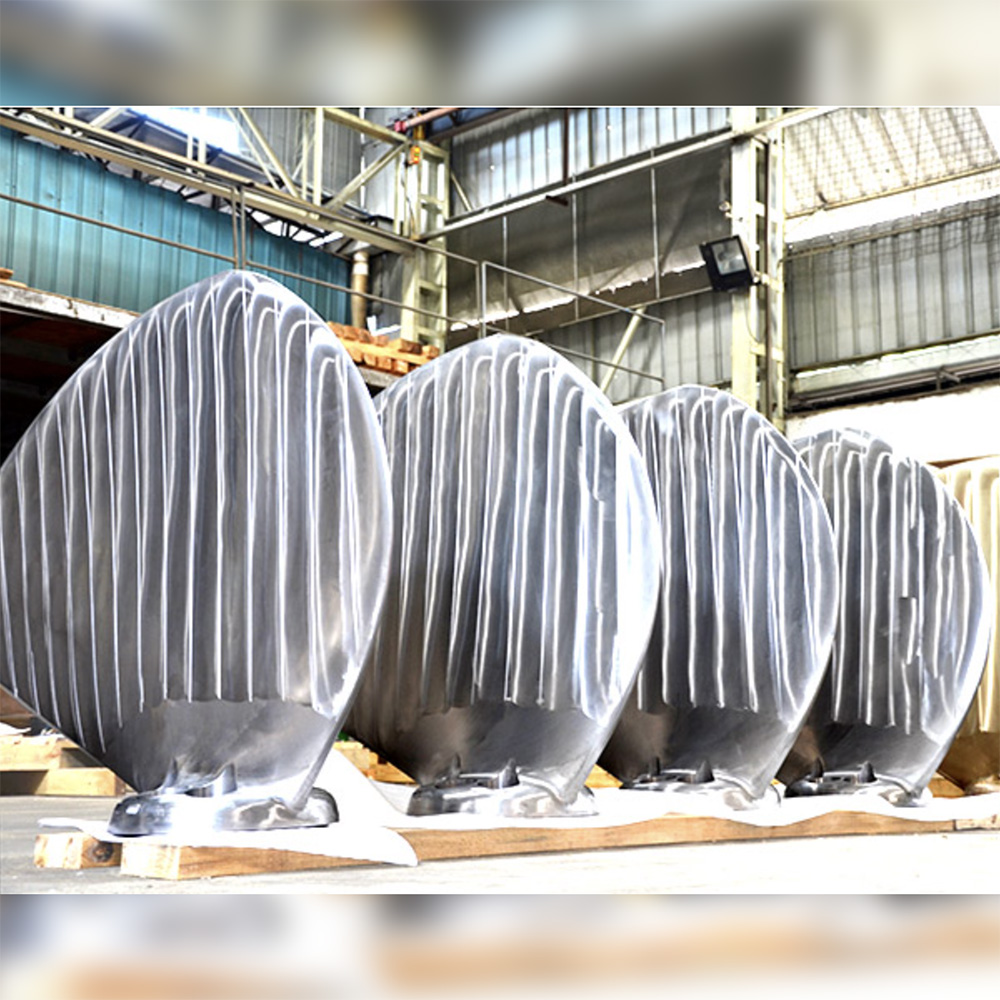
This product is a stainless steel controllable-pitch propeller (including blades and hub). It is specially designed for icebreakers, polar research vessels, and special ships requiring frequent variable working conditions and high maneuverability. We have overcome the casting and machining challenges of complex high-hardness stainless steel components, providing you with high-value-added customized solutions.
Professional casting, precision machining of various stainless steel CPP blades and hubs, and complete stainless steel propeller manufacturing services. Capable of producing ultra-large stainless steel CPP components with a maximum weight of 45 tons and a diameter of 7.5 meters.
Multi-Condition Adaptation: By changing the blade angle, optimal matching of main engine power is achieved under various working conditions such as sailing, towing, and reversing.
Polar Icebreaking: Applied to "icebreaker stainless steel propellers", utilizing high-strength stainless steel materials to resist ice cutting and impact.
Rapid Response: Maintaining the main engine's direction and speed unchanged, rapid reversal of thrust can be achieved solely by changing the pitch through the hydraulic system, greatly enhancing the vessel's maneuverability.
Overcoming Manufacturing Barriers: The blades and hubs of stainless steel CPPs are integrally or complexly separately cast, featuring extremely high hardness and machining difficulty. Our company has successfully mastered the core casting and precision machining processes for CPP hubs and blades made of martensitic and austenitic stainless steels (such as 08Х14НДЛ, 0Cr13Ni4Mo, 0Cr16Ni5Mo, 12Х18Н10Т, etc.).
Coexistence of Cost and Value: Although the processing cost of stainless steel CPPs is typically 2 to 3 times that of copper CPPs of the same specifications, their extremely high strength, impact resistance, and service life make their full life-cycle cost-effectiveness irreplaceable in harsh environments such as polar routes.
Parameter Item | Customizable Range | Remarks |
Material | Stainless Steel (08Х14НДЛ, 0Cr13Ni4Mo, 0Cr16Ni5Mo, 12Х18Н10Т, etc.) | Selected based on vessel type & operating conditions |
Diameter | Customized per design, maximum diameter 7.5m | Any size customizable |
Number of Blades | 3 / 4 / 5 / 6 Blades | Affects vibration & efficiency |
Pitch Ratio | 0.6 - 1.6 (Customized as per drawing) | Designed based on speed requirements |
Rotation Direction | Right-hand / Left-hand / Contrarotating | Determined by main engine configuration |
Manufacturing Process | Precision Casting + 5-Axis CNC Machining / Monobloc Casting | Ensures blade curve accuracy |
Surface Roughness | Ra ≤ 3.2 μm - 6.3 μm (Finer upon request) | Reduces frictional resistance |
Weight | Calculated per final drawing, maximum single-piece weight 45 tons | Weight certificate provided |
Certification | Factory Certificate / Classification Society Approval (ABS, BV, CCS, DNV, LR, etc.) | With customer's request |
Heat Treatment: Complex solution and aging heat treatments for stainless steel to ensure the matching of material hardness and toughness, and to eliminate casting stress.
High-Hardness Cutting and Grinding: To address the high hardness of stainless steel, carbide cutting tools and special cutting fluids are used to perform high-precision grinding on blade root flange mating surfaces and sealing positions.
Surface Strengthening: Focused polishing of the blade root and flange transition areas to eliminate stress concentration and prevent water-medium fatigue corrosion.
Non-Destructive Testing (NDT): Deep ultrasonic and magnetic particle inspections on pressure-bearing hubs and load-bearing blade roots to ensure zero defects.
Dynamic Balancing: Strict control of blade weight differences to ensure smooth operation of the pitch-changing mechanism.
Final Inspection and Assembly: Three-coordinate dimension measurement and dye penetrant inspection of mating surfaces to ensure smooth on-site installation.
Protective Treatment: Anti-rust oil or protective agents are applied to key machined surfaces to prevent corrosion during transportation.
Cushioning and Fixation: Wooden supports or special support structures are used to fix the product, which can prevent deformation or collision during transportation.
Outer Packaging: The product is packed with customized wooden cases or steel frames, which are suitable for sea transportation and long-distance transportation.


